 Today, the Texas Public Policy Foundation released five papers that together form a responsible strategy for the state’s immediate and long-term economic growth.
“These five approaches make for good economic policy anytime,” said TPPF Chief Economist Vance Ginn, Ph.D. “But they are especially important as the state recovers from government-imposed shutdowns. Together, these strategies will help return Texas to the prosperity we saw before COVID-19 and help get us there fast.” The Five-Step Strategy is:
“During the shutdown, the state suspended some rules and regulations, proving they weren’t essential for health and safety in the first place,” said Rod Bordelon, TPPF’s Policy Director for the Remember the Taxpayer Campaign. “Instead of waiting for the crisis to end to re-evaluate these regulations, we should repeal them now and review others in an ongoing basis so that Texans aren’t held back by unnecessary restrictions.” The Responsible Recovery Agenda also stresses that budget writers should avoid seeking additional state revenue through increased fees and taxes. “Raising taxes is a costly endeavor — even more so in a recession because it distorts behavior at a time when the economy is weak, delaying recovery and leading to even greater economic stress,” said Benjamin Priday, Ph.D., Economist at TPPF. “Legislators should close budget gaps first by strategically employing the Rainy Day Fund and by trying to find ways to reduce spending. The Responsible Recovery Agenda is a comprehensive approach to addressing the budget challenges Texas faces in the wake of COVID-19 shutdowns while also preserving the success of the Texas Model, which has strengthened the state’s economy. For a historical look at the budget and other ways to improve the budget process, the Foundation also released The Real Texas Budget report. In this Let People Prosper episode, we discuss local government transparency and efforts to rein in progressive policies like government-mandated paid sick leave, state reforms to the criminal justice system, and the failure of the Texas House to pass a Conservative Texas budget...but there was a good discussion about property tax relief!
#letpeopleprosper In this Let People Prosper episode, we discuss how to unveil government excess whether it be with pension obligation bonds, bail (register for upcoming TPPF event), occupational licensing burdens reduced for military spouses, TRS pension structural problems, and the Texas House budget that increases far more than the average taxpayer's ability to pay.
#letpeopleprosper TxLege Review on Sunshine Week, Bad Occ Licensing Bills, CJ Reforms: Let People Prosper Ep 803/11/2019 In this Let People Prosper episode, James Quintero, Derek Cohen, and I go over this week's key issues in the Texas Legislature.
These include issues related to the following:
#letpeopleprosper Current Events Friday includes Jobs Report, Annexation, & Criminal Justice Reforms: LPP Ep 793/8/2019 In this Let People Prosper episode, James Quintero, Dr. Derek Cohen, and I discuss today's release of reports on the U.S. and Texas jobs picture, movement on annexation reform (HB 347), and various issues related to criminal justice reforms (HB 63). Find more of TPPF's work at www.txlegehub.com.
#LetPeopleProsper Week 2 TXLege Happenings--Ban Income Tax, Cut Property Tax, & Free Trade: Let People Prosper EP 661/18/2019 In this #LetPeopleProsper episode 66, let's discuss what happened during Week 2 of the 86th Texas Legislature. My op-ed on the need to ban a personal income tax in Texas in the Victoria Advocate was tweeted by Governor Greg Abbott. That op-ed also noted the need to cut the school maintenance and operations property tax with TPPF's plan of simply slowing government spending growth. And I had another piece in The Hill that noted the benefits of free trade. Finally, the Legislative Budget Board adopted a spending limit based on population growth and inflation last Friday. Near the end of the discussion (watch starting at 6:20), Chair Jane Nelson notes, at Speaker Dennis Bonnen’s request, that The Honorable Talmadge Heflin said TPPF wouldn’t include Harvey-related money in budget figures. This is correct as long as it is transparent and one-time funding. It's a pleasure to work with him every day. Regarding the recent budgets, we posted a blog post with more information comparing the House and Senate budget recommendations with the Conservative Texas Budget. #letpeopleprosper 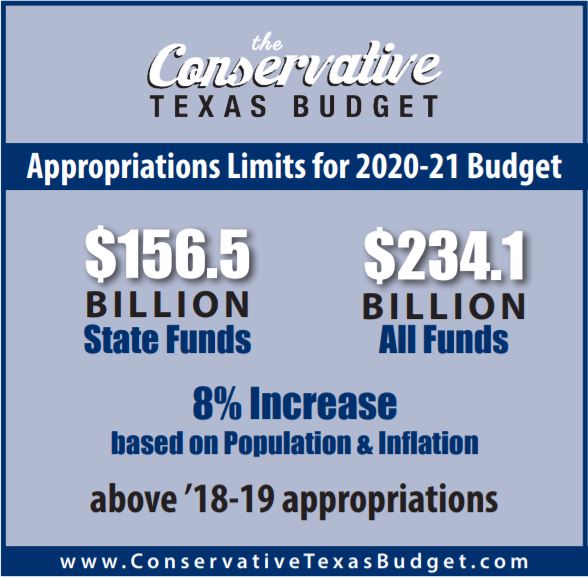 In this Let People Prosper episode, I provide today's press conference of the 18-member Conservative Texas Budget Coalition, with special thanks to Senator Donna Campbell for standing with us on these key legislative priorities, along with my explanation of the details of each of these priorities and how they work together to let people prosper. The Coalition outlined its legislative priorities for Texas' upcoming 2019 session. This includes the Conservative Texas Budget that sets limits for the 2020-21 budget of $156.5 billion in state (non-federal) funds and $234.1 billion in all funds to effectively limit spending so tax relief can be realized by all Texans. Read today's press release with quotes by each of the members of the Coalition. This is important because spending trends since 2004 outlined in the Real Texas Budget show that Texas families of four are paying $1,000 more, on average, in state taxes than if the budget had just matched population growth and inflation. Moreover, if the Texas Legislature can hold spending within a 4 percent growth limit this session and thereafter, Texas can eliminate the school maintenance and operations property tax--nearly half of the property tax burden statewide--within about 11 years. Read this for details of this simple property tax relief plan. As noted on the Coalition's website, other legislative priorities includes strengthening government spending limits, eliminating the business margins tax, creating a tax relief fund, and increasing budget transparency to let people prosper. 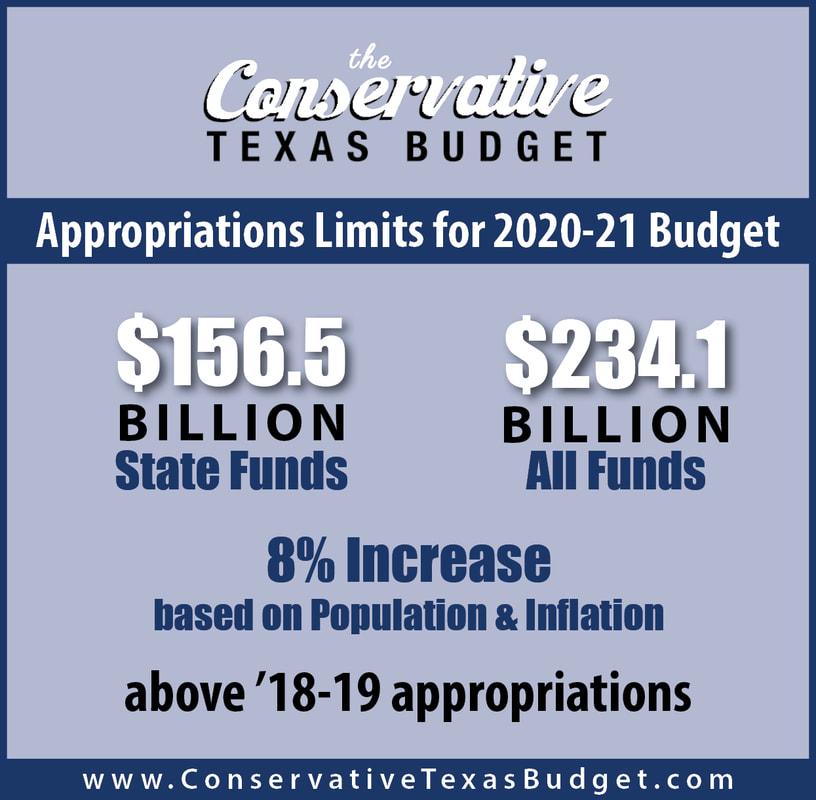 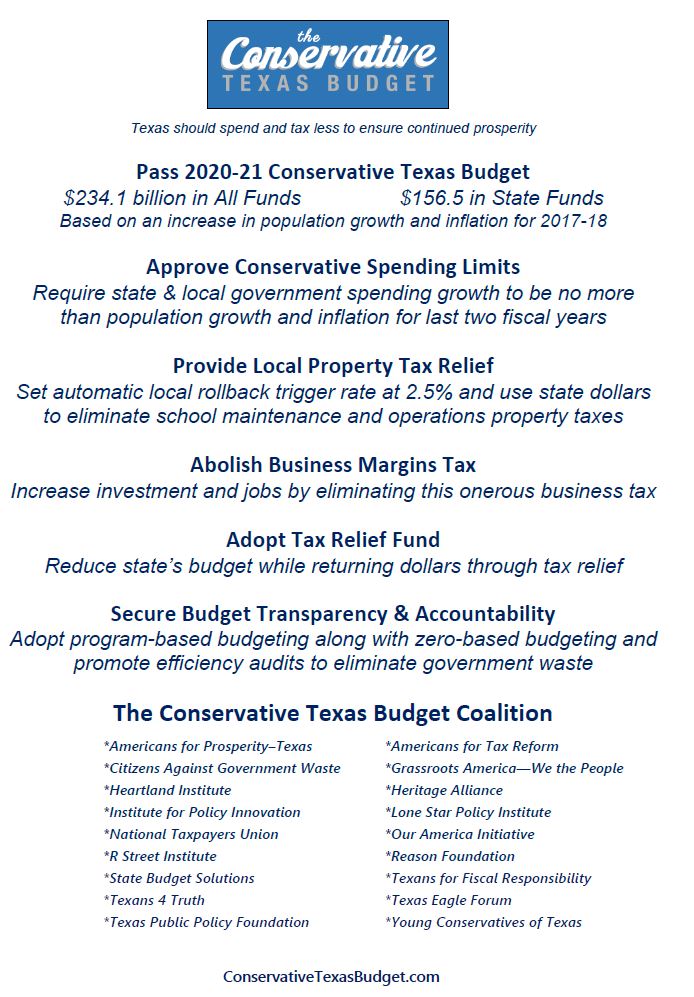 
U.S.-Mexico Deal & Testimonies on Occupational Licensing and Budget Transparency: LPP EP 348/28/2018 In this #LetPeopleProsper episode, I discuss my last two very busy days.
With the proposed U.S.-Mexico trade deal yesterday, I was on multiple radio stations today across the nation talking about the costs and benefits of the deal and the implications for Americans. I'm still waiting to see all of the details and am lukewarm about it at this point because of the trade barriers imposed on the auto sector that will lead to higher auto prices for consumers and higher transportation prices for many businesses. However, I'm optimistic that much of NAFTA remained intact, e-commerce provisions were included to modernize the agreement, and the contract is for 16 years instead of the 5 years the Trump administration suggested. Here's my recent commentary at The Hill on this issue. I testified today before the Texas Senate Business & Commerce on deregulating occupational licensing, which is the most onerous form of labor market regulation (here's my testimony). I discussed the high costs of these and made recommendations on taking a broad look at eliminating many of them or reducing their requirements along with moving towards having employers complete a registration or certification with the state government or a private association to signal that they are able to do the job, which signaling is about all many of these licenses are good for. I'll have a paper published on this soon with Dr. Ed Timmons of St. Francis University. I also testified today before the Texas Senate Administration on the benefits of program-based budgeting and the need for zero-based budgeting. I explain this in detail in the episode, but basically our state budget today is organized by strategy that lacks transparency and makes it difficult to find granular data in the budget, especially to weed out unnecessary programs. By moving to a program-based budget that's been used in Texas before, this granular data would be available to add transparency for taxpayers and legislators while making it easier to start each program at zero and make decisions whether it should be included--otherwise known as zero-based budgeting. Please watch the video for more. Don't forget to subscribe to my YouTube channel at "Vance Ginn Economics" and continue to share this with your friends and family. Thank you! #LetPeopleProsper In addition to this fiscal recap of the 85th Legislative Regular Session, the file below provides an overview of the 2018-19 Texas Government Budget while avoiding any smoke and mirrors. Transparency and accountability are essential for the use of taxpayer dollars.
The Conservative Texas Budget (CTB) limits the Legislature’s increase in appropriations for the 2018-19 biennium to no more than population growth plus inflation. As the budget heads to the conference committee for final negotiations before consideration by both chambers, the passed versions of SB 1 by the Senate and the House indicate that they can keep appropriations below the CTB limits.
https://www.texaspolicy.com/content/detail/texas-2018-19-government-budget-comparison Testimony before the Senate Finance Committee in support of SB 1831.
https://www.texaspolicy.com/content/detail/increasing-transparency-accountability-of-texas-taxpayer-dollars Testimony before the House Appropriations Committee in support of HB 3849.
https://www.texaspolicy.com/content/detail/reducing-state-budget-reliance-on-dedicated-accounts Testimony before the Senate Finance Committee on Budget Transparency
By Vance Ginn, Ph.D. Chair Nelson and Members of the Committee: My name is Dr. Vance Ginn and I am an economist in the Center for Fiscal Policy at the Texas Public Policy Foundation, a non-profit, non-partisan free market think tank based here in Austin. Thank you for taking the time today to investigate the important issue of improving budget transparency. My remarks today will focus on ways to provide Texans and their legislators with a clearer picture of how their tax dollars are spent. The current strategic budget format of Texas’ budget makes it challenging for experts much less ordinary citizens to track funds in the budget. This format was first used in the 1993 appropriations bill with the goal of providing legislators with a longer-term view of budget goals beyond the two-year appropriation cycle. Although this is a reasonable goal, the strategic budget format provides only broad goal statements instead of providing a line item for the funding amount of each agency program that the public could use to determine the effectiveness of their tax dollars. The problems associated with this format lead to reduced budget transparency contributing to less accountability and efficiency in the appropriations process. For example, it was clear in the 1989 appropriations bill that the Legislature appropriated $2.9 million for legal services and $26.2 million for enforcing tax compliance in field operations. However, there was no way to determine these line items in the 1993 appropriations bill—or thereafter. One could determine from the 1993 appropriations bill that $177 million was appropriated for tax compliance and within that number was $98 million for “Ongoing Audit Activities,” but it is not possible to see how much was appropriated for legal services. The lack of transparency poses a major challenge for taxpayers and legislators. By obscuring the amount of funds approved for each agency program or service, there is little incentive to remove programs that are ineffective because it is almost impossible to single them out. This makes it difficult for Texans to communicate with their legislator on what spending to vote for and makes it difficult for legislators not directly involved with writing the budget to determine their spending priorities. To overcome the shortcomings of the strategic budget format, the state should convert to a program-based budget format. The budget should be written so that each agency’s income and expense is listed by program, as is done in the agency’s own internal budget. In addition, the source of funds should be listed for each line item. This change is a way to simplify the budget process for taxpayers and legislators to review programs that may need to be eliminated, reduced, or increased and more easily identify and deal with any waste, fraud, and abuse. During the 82nd Texas Legislature, HB 2804 and SB 1653, along with the first part of SB 1433 during the 84th Legislature that did not receive a hearing, would have taken steps toward program-based appropriations. Although neither bill passed, a scaled-down version of HB 2804 placed in Section 34.06 of Senate Bill 1 directed the Legislative Budget Board (LBB) to put program-funding details online. This contributed to the development of an online application that presents the budget in a program-based format on the LBB’s website. This provides an example of what the program-based budget could look like. While this online application provides valuable information, it is updated months after the appropriations bill is approved, providing neither taxpayers nor legislators with timely budget details on specific programs within state agencies during the appropriations process. Our second recommendation remedies this issue by requiring budget information to be online in real time or near real time throughout the budget process. Taxpayers would be able to access past spending for each budget line item along with the proposed appropriations levels for the upcoming biennium. If it is not too cumbersome, the data could be originally posted when state agencies submit their funding requests, then updated once appropriation bills are drafted and filed. Updates should be made online throughout the legislative process as changes are made during hearings and after final adoption of the appropriation bill. This information should be available in an online application and downloadable as a spreadsheet. It is reasonable to expect the Legislature to provide transparency and accountability of taxpayer dollars so Texans understand the benefits achieved with their money. As the next session approaches, the Legislature would do a great service to Texas taxpayers and legislators by converting from a strategic budget format to a program-based budgeting layout and provide budget information online in real time throughout the budget process. Until this is accomplished, we recommend the LBB put the program-based budget format online throughout the legislative process. In summary, the Foundation recommends the following to achieve increased budget transparency:
Thank you for your time and I look forward to answering your questions. http://www.texaspolicy.com/content/detail/testimony-budget-transparency-now |
Vance Ginn, Ph.D.
|
||||

 RSS Feed
Proudly powered by Weebly