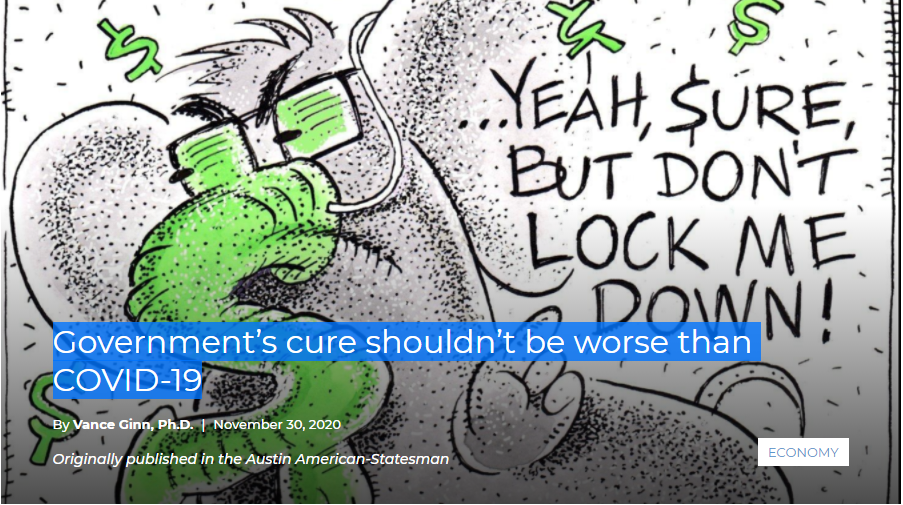
 COVID-19 continues to take a toll in the U.S., with more than 13 million cases and over 260,000 deaths. The rise in cases has led to interventions by state governments.
Given that the health threat is real, we should learn from what has worked —and what has not. That means we must work hard on a vaccine, protect the vulnerable, and let most people live their lives. Michigan, New Mexico, Oregon and Washington have closed most businesses. New Mexico has issued a shelter-in-place order. Other states have started mandating masks. Some Texans are pushing for more interventions even as we’ve had a statewide mask mandate since July 2. While these interventions are well-intended, blanket and indefinite policies simply aren’t warranted. Such policies have already cost millions of jobs. During the lockdown that started in March, many Texans’ livelihoods suffered a devastating blow. The state’s economy contracted by a record 29% on an annual basis in the second quarter of 2020. This contributed to at least 8,900 shuttered businesses, losses of 1.3 million jobs in the private sector, and an unemployment rate that skyrocketed to 13.5% through April. In a survey taken at the end of May, 16% of Texans said they were facing financial ruin, and 22% said it would take them a year or more to recover. These figures likely have worsened since then. After reopening some businesses in May and then reversing course over the summer, Gov. Abbott changed the method for assessing how and when to expand capacity at certain business venues. The new system—considering COVID-19 hospitalizations as a share of hospital capacity in each of 22 trauma service areas — allowed a more targeted, timely, and temporary approach. And it reflected the intent of the initial lockdown response to “flatten the curve” so hospitals wouldn’t be overwhelmed. If a trauma service area has a rate for seven straight days in which less than 15 percent of total hospital capacity has been COVID-19 patients, then most businesses there can expand from 50% to 75% capacity. Currently, 94% of Texans are in areas that can be at 75% capacity—contributing to more economic activity. But state totals of COVID-19 cases and hospitalizations have been at or near their highest since the pandemic started. This has initiated calls by the Statesman’s Editorial Board for people to act responsibly, for a new path in Texas’ response that has been “marked by high hopes and half measures,” and for a “serious national strategy.” But Gov. Abbott rightfully said lockdowns are off the table: “Our focal point is going be working to heal those who have COVID, get them out of hospitals quickly, make sure they get back to their normal lives,” he said. With several vaccines getting closer to being available and with Pfizer announcing a pilot program to deliver the vaccine quickly in Texas, there is no reason for a lockdown. Let’s acknowledge we can’t get to zero cases and deaths without eliminating liberty and livelihoods, and let’s better allocate our efforts in a targeted, temporary, and timely way until the vaccine is readily available and population immunity occurs. https://www.texaspolicy.com/governments-cure-shouldnt-be-worse-than-covid-19/ Read the full newsletter with charts and subscribe here.
Hello Friends! Thank you for reading my Let People Prosper newsletter! Please keep sharing it with others who may be interested in our productive discussions. Many thanks in advance! I hope you have a fantastic week of finding things to be thankful for as we approach Thanksgiving. May you be blessed with good health, prosperity, and wisdom every day. Keynote Speech: I enjoyed the opportunity to give the keynote speech at the Free Market Institute at Angelo State University on Tuesday, November 17. This presentation was part of the Free Market Institute at Texas Tech University's Public Speaker Series, where I explain the economics of how institutions, tradeoffs, and policy matters when dealing with this situation. You can watch and view my slides at the link in my tweet below. I included a number of slides in my presentation that walked through where we were before COVID-19 hit, where we have been since it hit, where we are now, and where we should head.If you have any information to share along these lines, please send my way. Also, please unsubscribe at any time. I hope this newsletter is marginally beneficial to you and will hopefully help us to find opportunities to let people prosper. Have a blessed week of thanksgiving. And try to educate yourself on things to tame your fear, and focus instead on your spirit of power, love, and self-discipline. Vance Ginn, Ph.D. | www.vanceginn.com | #LetPeopleProsper  Shutdowns and stay-at-home orders across Texas due to COVID-19 have spiked unemployment, slowed tax receipts, and forced the permanent closure of 8,900 Texas businesses since March. This, from one of the most dynamic and fast-growing economies in the world.
A return to previous success is possible, and necessary, by safely reopening Texas and promptly strengthening its institutions. The Texas Model of relatively limited government, along with the pro-growth policies of the Trump administration, provided an institutional framework that helped create an attractive economic environment to let people prosper. In 2019, Texas led the nation with GDP growth of 4.4% and with the most jobs added of nearly 350,000 (and the fourth-fastest growth rate of 2.7%). Also, Texas had the lowest supplemental poverty measure rate of 13.7%, (the SPM accounts for cost of housing differences across the nation and other key metrics), compared with other large states of New York (14.4%), Florida (15.4%), and California (17.2%)—the highest in the nation. In addition, the Texas model was strengthened by a voter-approved constitutional ban on a personal income tax last year, property tax relief through reform and reductions, and a track record over the last three sessions of passing conservative budgets. But these benefits couldn’t withstand the economic destruction of fear. Fear led the public to decrease their interactions early on during the COVID-19 pandemic, before state and local governments created a whiplash of openings and closures with questionable results. At the state level, Texas Gov. Greg Abbott issued a disaster proclamation on March 13, near the start of the pandemic, and then a stay-at-home order on March 31. Some restrictions were lifted on April 17 and more were eased a couple of weeks later before another the rise in COVID-19 cases and positive tests—both have been questionable measures to consider when making policy— over the summer raised concern, resulting in a statewide mask mandate and further restrictions. This sort of uncertainty makes it practically impossible for entrepreneurs to run a business or for job-seekers to find steady employment. The recently released GDP by state figures for the second quarter of 2020 accounted for this destruction. Dealing with a U.S. economy contracting by an annualized rate of 5% in the first quarter and 31.4% in the second, Texas’s GDP shrank by a record-breaking 29% in the second quarter. But this put it in the second quintile of best-performing states, if contracting at a record annual pace can be considered “best,” with less loss than Florida (-30.1%), California (-31.5%), and New York (-36.3%). While the third quarter growth improved dramatically across the U.S., the same is true in Texas as some restrictions were eased. And on Sept. 17, Texas changed the metric used to evaluate the situation to COVID-19 hospitalizations as a share of all hospitalized patients, which aligns with the initial reasoning for government overreach to avoid overwhelming hospital capacity. This allowed some trauma service areas (TSA) with that metric below 15% for seven consecutive days to open most businesses to 75% capacity. Then, on Oct. 7, a new Executive Order was issued that changed the metric to COVID-19 hospitalizations as a share of total hospital capacity, an improvement that better accounts for the flexibility that hospital managers have with beds. This order also expanded most businesses capacity to 75% in TSAs with less than 15% of this metric and allowed bars to open to 50% capacity—assuming a county’s judge approves it, which hasn’t been the case in most large urban counties. The new metric results in only three (Amarillo, Lubbock, and El Paso) of 22 TSAs with a hospitalization rate above 15%, as of Nov. 9, meaning that 94% of Texans can have access to 75% of certain business capacity. As COVID cases rise once more during flu season, calls for a second round of harsh restrictions are sure to happen. What these demands fail to understand is that the re-opening measures in place are not due to a blind indifference to human suffering, but rather a different, better path to evaluate tradeoffs. In addition, the catastrophic drop in GDP across the state was due in no small part to the swinging pendulum of shutdown to rollback to shut down again, with unemployment rising to a historically high 8.3%. Another statewide shutdown would deal another staggering blow to an economy recovering from the fallout of the pandemic. The Texas Model was responsible for the economic boom before the pandemic, and what comparative success we’ve had during the COVID-19 crisis was due to efforts to roll back restrictions in line with that model. If the state is to fully recover, the next steps to do so must be made clear soon as without it the uncertainty and fear will contribute to more job losses and the demise of the once successful Texas Model. https://www.texaspolicy.com/covid-19-must-not-break-the-successful-texas-model/ Watch my presentation “Was the Cure Worse than #COVID19?” This presentation is part of the Free Market Institute at Texas Tech University's Public Speaker Series, where I explain the economics of how institutions, tradeoffs, and policy matters when dealing with this situation. You can also view my slides below. Read the full newsletter with figures and subscribe here.
Hello Friends! Thank you for reading my Let People Prosper newsletter! Please keep sharing it with others who may be interested in our productive discussions. We’ve got a lot to accomplish together, so I need your help in growing my subscribers. Many thanks in advance! Humble Yourself: This is an important reminder given the rise again in many politicians’ desire to do something like lockdowns to deal with rising COVID-19 cases but nothing or something much more targeted is best. We can learn a lot from economists Friedrich Hayek and John Maynard Keynes, but more importantly from the Bible. If you have any information to share along these lines, please send my way. Also, please unsubscribe at any time. I hope this newsletter is marginally beneficial to you and will hopefully help us to find opportunities to let people prosper. Have a blessed rest of your weekend. And remember to humble yourself this week. Vance Ginn, Ph.D. | www.vanceginn.com | #LetPeopleProsper  With the Texas economy reeling in the wake of the COVID-19 pandemic and the resulting statewide shutdowns, economic recovery will be the top issue for the upcoming legislative session. Key to any attempt at recovery will be determining how much the state should spend.
The prosperity of many Texans at stake and the Texas Legislature ought to consider fiscal savings to cover any shortfall in the current budget period and pass a responsible budget in the upcoming session that starts in January. The Texas economy has taken a beating from the COVID-19 pandemic and associated lockdowns by state and local governments. Many Texans are struggling. And a recent national poll found 65% of voters say it will take more than a year for the U.S. economy to recover. As Texas continues to recover, the necessity of keeping the government’s hands out of the taxpayer’s pockets is as important as ever. As the economy recovers, the natural inclination is to spend as much as necessary to support Texans reeling from the effects of COVID-19. However, the old adage that there is no such thing as government funds, only taxpayer funds, should be at the front of legislators’ minds as they attempt to address the fallout from the pandemic. With that spirit in mind, we at TPPF recently released our latest 2022-23 Conservative Texas Budget (CTB) that sets a maximum threshold on appropriations at $246.8 billion. This amount is the result of increasing the 2020-21 appropriations by 5% growth rate, which was calculated using the state’s population growth plus consumer price inflation to capture taxpayers’ ability to pay for their government. These appropriations exclude extraordinary funds that shouldn’t go into the baseline budget because they’re one-time costs, such as funds to Hurricane Harvey recovery and property tax relief last session and those explicitly to COVID-19 efforts. The CTB has been a success in the sense that it has helped give state officials a maximum benchmark with which to hold appropriations to within taxpayers’ ability to pay for it. By limiting growth in the budget, legislators have helped strengthen the Texas Model of low taxes and more freedom by cutting the business margins tax and property taxes by billions of dollars since the 2015 session when TPPF created the CTB. Specifically, the average growth of the two-year state appropriations fell from 12% during the five budgets from 2004 to 2015 to an average of just 5.5% during the last three budgets. And after appropriations grew well above population growth plus inflation of 7.3% in the earlier period, the more recent growth was below this key metric of 6.3%. This fiscal responsibility in the last three budget cycles must be continued because the excess in the earlier period has compounded to put more pressure on taxpayers’ budgets. For example, if the state had adhered to this metric every budget period since the 2004-05 budget, appropriations would be $37.3 billion less, saving families of four, on average, about $2,500 per year—savings which would have been invaluable with the lockdowns’ lost wages and jobs. Texas Comptroller Glenn Hegar recently reported that state sales taxes were down a whopping 6.1% in September over the prior year. This has contributed to a projected $4.6 billion deficit by the end of fiscal year 2021. Any attempt to raise appropriations above population growth plus inflation or raise taxes fails to take into consideration this deficit because it will detrimental to the recovery. The responsible action now is to cut spending as much as possible to make up the shortfall. And to help put Texans on the best path to a full recovery from this unprecedented situation is to consider cutting wasteful and unnecessary appropriations at the very least not appropriate more than the Conservative Texas Budget in the upcoming session. Doing so will improve the proven successful Texas Model so more people have the chance to fully recover much faster than anticipated. After the year we’ve had, we need a clear conservative fiscal approach in the upcoming session. https://www.texaspolicy.com/nows-the-time-plan-for-a-conservative-texas-budget/  Americans want to return to work after months of joblessness due to the COVID-19 pandemic-related business closures. But too many Texans can’t—because of the industry they work in.
There was some hope that this might change after Gov. Greg Abbott’s executive order that took effect on Oct. 14 expanded the state’s reopening plan by adding bars to the list of certain businesses allowed to partially open. But one of the stipulations in the order to open bars to 50% capacity is already proving hardest to overcome: gaining the approval from the county judge. Despite low COVID-19 hospitalization rates in most of the 22 trauma service areas across the state, many bars do not have the judge’s approval they need to open. This limitation—among others—hits many Texans while they’re down. For example, Texas’s 8.3% unemployment rate in September is historically high and substantially higher than the near record-low rate of 3.5% in February before the COVID-19 pandemic. Under the latest order, fewer restrictions are placed on those areas that are below the 15% threshold metric of COVID-19 hospitalizations as a share of total hospital capacity for at least seven consecutive days. These areas can have most businesses expand to 75% capacity and allow bars to open to 50% capacity with the approval of the county’s judge. But if an area’s metric is above this 15% threshold for seven straight days, then certain businesses are rolled back to 50% capacity and bars must close. Fortunately, this order allows a more targeted policy approach to focus public and government assistance on populations that need it most. The chosen metric also helps bring a more objective measure that’s less susceptible to manipulation—intentional or otherwise—while supporting the government’s initial argument for preventing COVID-19 from overwhelming hospitals. While this is an appropriate and safe step towards opening Texas, uncertainty remains for employers and workers who are left in the dark without a timeline for when the state will be fully open. In other words, when will Texans have their freedoms back so that they can live out their dreams responsibly? This sort of certainty is what will help give people a sense of calm in this storm and support a more vibrant economy that will lead us back to a robust situation like we had in February. Adding to the current uncertainty, local officials are making bad decisions by refusing to rely on the evidence. Specifically, many of the major county judges insist that the threat levels are still too high for any further reopening efforts. But the data indicate otherwise. In fact, as of Oct. 27, most areas where 94% of Texans reside are maintaining a hospitalization rate below 15% with only the three trauma service areas that include El Paso, Amarillo, and Lubbock on the restricted list. The evidence did not stop the counties of Dallas, Harris, and Travis from firmly putting their feet down when it comes to reopening bars. Judges in Dallas and Harris counties quickly announced their rejection of opting into the order despite their preceding seven-day COVID-19 hospitalization rate at that time holding steady around 8% and 4%, respectively. Dallas and Houston are not alone. The Travis County judge, which houses the state’s capitol in Austin, announced its intention to keep bars closed until further notice. Its preceding seven-day average was even lower than Dallas and Houston, running below 3%. In fact, the Austin area’s rate has been below the Governor’s 15% threshold since July 22. With numbers this low and personal responsibility in place, why shouldn’t bars and similar businesses be allowed to open? Failing to rely on the data when making life-altering decisions demonstrates that these decisions are not based solely on the health, safety, and livelihoods of Texans. If they were, Texas would be further along to fully opening, and Texans could live their lives more freely. The evidence supports further reopening and local officials would do right by Texans to allow it. One thing is clear: Texans want to get back to normal. https://www.texaspolicy.com/ending-prohibition-in-texas/ |
Vance Ginn, Ph.D.
|

 RSS Feed
Proudly powered by Weebly