 Originally published at Independence Institute. In 1992, Colorado voters adopted the Taxpayer’s Bill of Rights (TABOR) to limit the growth in state and local spending. Over the past three decades, however, politicians from both parties and a complicit judicial branch have exempted more and more state spending from the TABOR limit. When voters adopted TABOR, 67% of state spending was subject to the limit. Today, the majority of state spending is not subject to the limit. Consequently, state spending has far outpaced Coloradans’ incomes over the last decade. To uphold the original intent of voters when they adopted TABOR, Independence Institute proposes the Sustainable Colorado Budget (SCB), which limits state spending from state funds (excluding federal funds) at the rate of population growth plus inflation. The state should then use the surplus revenue above the SCB spending limit to reduce the income tax rate for all taxpayers.
0 Comments
 This commentary was originally published at The Center Square here.
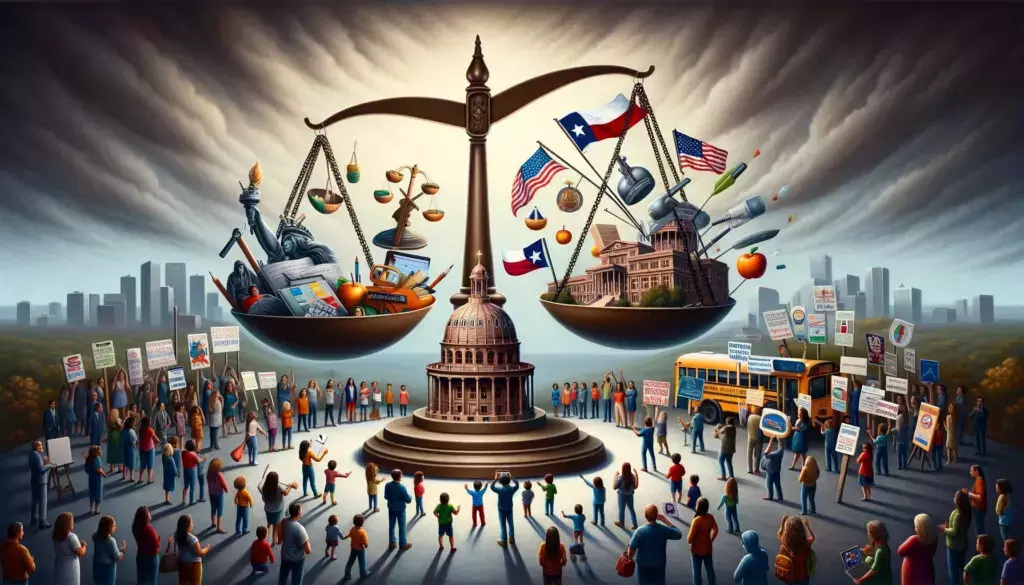
A record number of states have passed universal school choice so far this year, but it seems Texas won’t be among them. Given the lack of universal school choice in multiple bills this year, I’m relieved it hasn’t passed in Texas yet. I’ve long been a researcher and staunch supporter of universal school choice. The way to do this is by making the eligibility and funding for education savings accounts (ESAs) available for all 6.3 million school-age students. ESAs put the power of choosing kids’ schooling in parents’ hands by picking public, private, home, co-op, micro, or other types of schooling. ESAs would be funded through the current school finance system and other general funds or new tax credits as necessary. After the Texas Legislature failed to pass a school choice bill in the regular legislative session earlier this year, Texas Gov. Greg Abbott added school choice to the third and fourth special sessions. The first two special sessions focused on property tax relief and border security. The latest $7.6 billion K-12 education-related bill supported by Gov. Abbott in the fourth special session was killed in the House. The massive education bill died after Rep. John Raney, R-College Station, introduced an amendment to remove Texas’ first ESA program from the bill. The amendment passed with 21 Republicans joining all Democrats, essentially killing the bill as it likely is stuck until the special session ends Dec. 7. Gov. Abbott asserts that he will keep fighting for school choice, with the possibility of calling more special sessions. But trying to pass universal school choice before the next regular session in 2025 would be a mistake. This progress was historic as it was the first time since 2005 that a school choice bill had passed out of the House Public Education Committee and made it to the House floor. The Senate has passed school choice bills out of its chamber many times since then, including several times this year. The latest House bill allocated $7.1 billion for additional public school funding and only $486 million for ESAs. Put another way, that’s more than $14 for public schools for every $1 for school choice, which amounts to providing an ESA of $10,700 to only 45,400 students, or just 0.7% of the 6.3 million school-age kids. Texas is long overdue to join the growing number of states that have passed it. But there’s no path to real school choice for every student in Texas now because of politics, not from a lack of support among Texans. A recent University of Houston survey found that 47% of Texans support school choice “for all parents, regardless of income,” and only 28% oppose it. The support exceeds opposition to it across all demographics, including rural areas. The politics of this is a strange bedfellows of some Republicans and all Democrats spreading fear based on teacher union claims that public schools won’t survive. But doesn’t that fear concede that those schools in a monopoly government school system can’t compete and aren’t serving families well? The best chance to pass true universal school choice, not the minimal and problematic school choice in the House’s and the Senate’s bills, is to vote out representatives who prioritize teacher unions over Texans. Then, come back to the regular session in 2025 and pass a bill that won’t let Texans continue to fall behind. This is how to help students, parents, and teachers–who would see better pay and benefits through school choice. Gov. Abbott is leading the way. He recently endorsed 58 House Republicans who voted against Raney’s amendment and made his first endorsement of a candidate running against an incumbent who voted for the amendment. Some argue that more Texas public school funding is the answer instead of school choice. But as Texas continues to increase funding for public education to record levels, a recent public school ranking shows that Texas public schools rank 13th worst of all 50 states. In another ranking, only 23% of 8th graders performed at or above the National Assessment for Educational Progress (NAEP) proficiency level on its nationally recognized exam. This means that 77% of 8th graders in Texas scored below proficiency on this national exam. Clearly, the monopoly government school system is failing students in Texas. More funds will not fix this monopoly government school system problem; only more parental freedom will. Although history was made this year, these efforts aren’t enough. Universal school choice with ESAs for every parent to choose the type of schooling for their kids must be the outcome for better student outcomes, higher teacher pay, more parental opportunities, and greater taxpayer benefits. Gov. Abbott has been pushing the correct path of universal school choice for more than a year. But given the current makeup of the Legislature, especially in the House, he should give passage of school choice a rest for now. Texans can only hope that the 2024 election will yield a new wave of politicians who reflect what they want: putting kids first. What can state and federal governments glean from Iowa's example when it comes to responsible budgeting? Find out! If you value responsible government budgeting and fiscal conservatism, I believe you’ll enjoy this podcast episode. Thank you to Iowans for Tax Relief Foundation’s ITR Live podcast for having me on their show to discuss a conservative approach to balancing Iowa’s state budget, my time at the White House, and free trade. Listen on Apple Podcasts or YouTube! Original publication at Iowans for Tax Relief Foundation.  If you’d like to learn more about the responsible state budget revolution sweeping the nation, check out my post, where I dive deeper into the topic, including my extensive work helping reform state budgeting across the country.
www.chronicle-tribune.com/opinion/could-social-media-regulation-stifle-our-future/article_1dd66cd8-5e61-5e04-ac82-e9c56b12d166.htmlOriginally published at the Tribune.
This is the season of controversial big-government actions by Republicans and Democrats. They too often want to direct people’s actions toward how politicians see fit, through policies dealing with industrial support, climate change, and labor markets. One concern is regulating social media. From the Supreme Court’s scrutiny of Texas and Florida’s social media laws to Utah and other states unveiling social media rules for the digital world, parental rights and capitalism are at a pivotal moment. The policy choices we are making now on these issues will impact the brightest spot in the American economy. As economist Thomas Sowell correctly noted, there are no solutions, only trade-offs. This is a reason why it is crucial for Americans to grasp the trade-offs of social media regulation before politicians and bureaucrats take action. Utah’s ”Social Media Regulation Act” serves as a cautionary tale of government overreach with severe trade-offs. While the road to online safety is paved with good intentions, as we all want the best for minors (and everyone), we must evaluate policies by their real-world results. Utah’s law mandates minors under 18 must obtain a guardian’s permission to create social media accounts. If they proceed, the guardian gains full access to the minor’s account, with default curfew settings between 10:30 p.m. and 6:30 a.m. Additionally, minors cannot receive unapproved direct messages, and their accounts are blocked from appearing in search results. While there is mixed evidence suggesting a relationship between excessive social media usage and declining mental health, a recent study from Gallup reveals that parents have an even more prominent role than social media when it comes to well-being: “The strength of the relationship between an adolescent and their parent is much more closely related to their mental health than their social media habits. When teens report having a strong, loving relationship with their parents or caretakers, their level of social media use no longer predicts mental health problems.” Even if the mental health studies are correct, Utah’s law may not help teens most in need. Implementing government regulations always comes with a cost, and in this case, the very thing this policy intends to help could be harmed as a result. Parenting could be taken from parents and given to social media companies and government bureaucrats. Another trade-off looms: Will children growing up with restricted access to social media be disadvantaged compared to their counterparts in states and countries without such restrictions? Social media plays a key role, not just socially, but also professionally. The effect of limited exposure to these platforms remains uncertain. Beyond concerns about parental rights and career challenges, bills like these can seriously disrupt free markets and the prosperity we’ve seen them bring. Instead of restrictions, states and the federal government should focus on education. Indeed, many states are considering such digital literacy laws, following in Florida’s footsteps. On the free speech side of social media regulations, the bills in Texas and Florida aimed to prevent social media companies from selectively influencing digital expression. The Texas law was challenged in court and upheld; the Florida law was challenged and struck down. Now, these laws will be considered by the Supreme Court, and the outcome will have a big impact on the social media ecosystem. Although it’s frustrating for social media companies to potentially influence users by removing, promoting, or de-ranking specific content besides pornography, they are within their rights to do so. Content moderation practices, whether strict or open, bring a great opportunity for competition. For example, platforms like Rumble emerged in response to concerns that the big social media companies were unfairly moderating their content and attracting millions of users. This exemplifies the essence of free enterprise — problems inspire innovation, and competition drives improvement, allowing for diversification. But if social media companies in these states are compelled to adhere to the restrictive regulations, it will deter new startups and stifle growth. The social media landscape is evolving rapidly, and regulations like these demand careful consideration. While the safety of minors online is paramount, for our kids and yours, it’s crucial to strike a balance that preserves parental rights, encourages innovation, protects free speech, and safeguards individual freedoms. As we navigate this digital age, let’s remember that effective solutions should empower parents, consumers, and promote competition, not hinder progress with more government. These are the things that have provided the greatest human flourishing in free-market capitalism.  Originally posted at Pelican Institute where I co-wrote it with Jamie Tairov. The Pelican Institute has highlighted the need for better state budgeting and tax reform. This includes the Responsible Louisiana Budget (RLB), which was released earlier this year. The RLB shows that Louisiana’s budget has been growing at unsustainable levels, and that an improved growth factor for the expenditure limit and initial appropriations is needed. Recently, Americans for Tax Reform released a similar comparison for all 50 states, including Louisiana, in its Sustainable Budget Project. This report shows that, on the surface, Louisiana’s spending has not been as unsustainable as the RLB shows. Why is there a different outcome in the two reports?
Outcomes of Each Report The Responsible Budget model is currently being used successfully in other states to rein in spending. This is what Louisiana’s budget would have looked like had the RLB been employed over the last ten years. 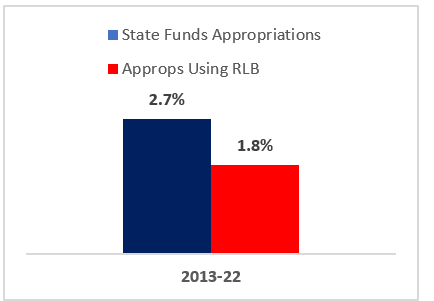
Here are the findings from ATR’s Sustainable Budget study over the last decade:
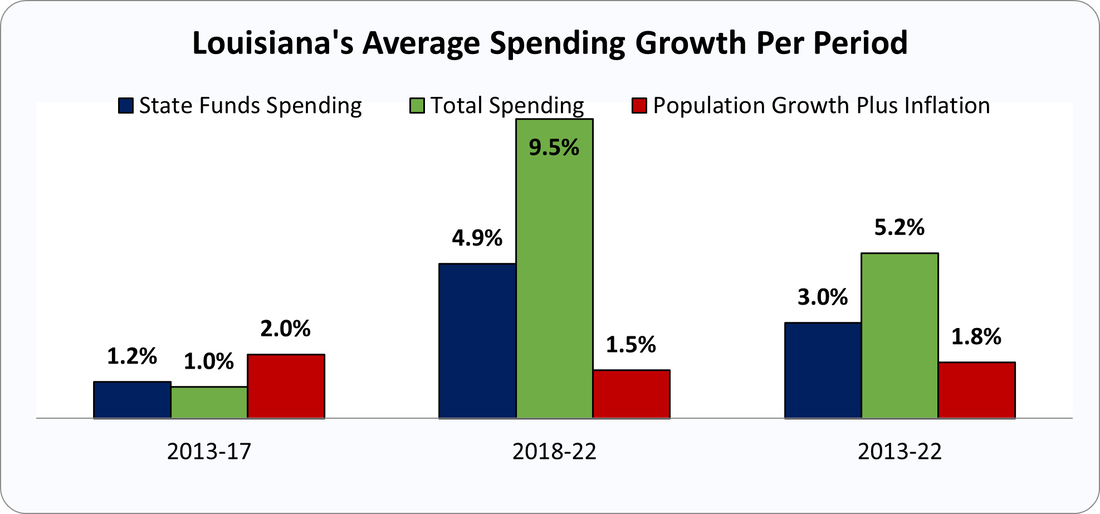 Total spending in FY 22 was 34.4%, or $11.2 billion, higher than the improved expenditure limit. This means that a family of four is paying $8,800 more in taxes to pay for the excess spending, which is not sustainable spending. 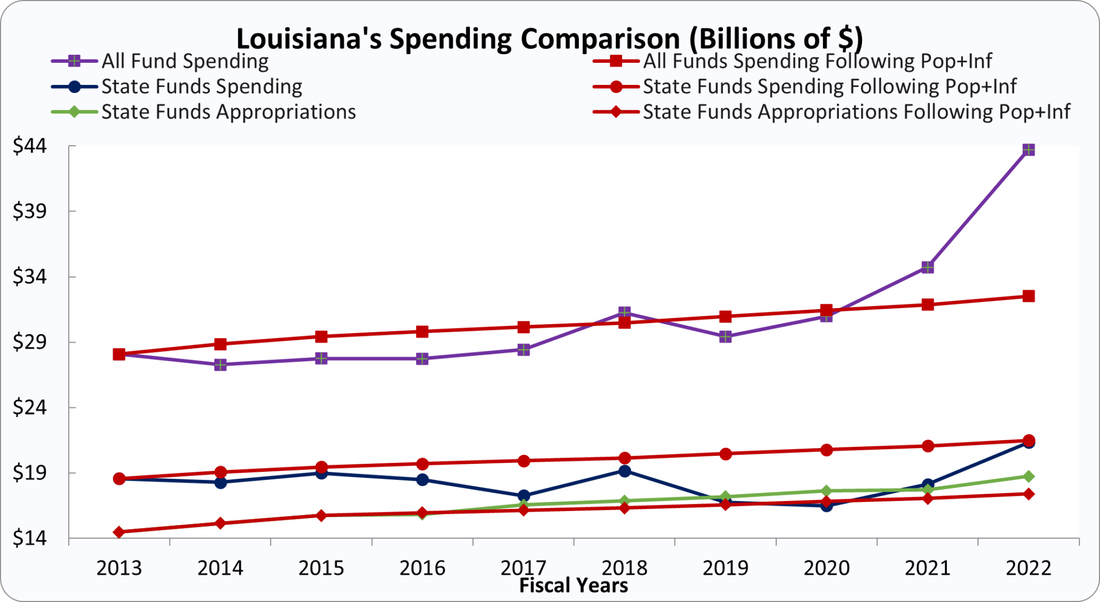 Is One Report Better Than the Other?
No. Both reports are accurate and serve different purposes. The RLB uses initial appropriations which helps lawmakers easily compare appropriation amounts from year to year as they are drafting the budget during session. Because it covers spending instead of appropriations, the ATR study is a backwards-looking metric that can be used for making longer-term spending decisions, but it will be limited in its use during a legislative session. Both reports compare the current expenditure limit with a proposed improved expenditure limit. The current limit is the three-year average of personal income growth, which is an extremely volatile measure. The proposed improved limit is the three-year average of population growth plus inflation. The RLB and ATR reports can work together, providing limits on the front and back end to ensure that spending remains responsible throughout the year. Both reports show recent elevated appropriations and spending. There is clearly room for budgeting restraint in Louisiana. These measures have benefits to lawmakers and the public so that they can have the tools necessary to restrain government spending and provide a responsible budget. Doing so will have many payoffs over time, including making the comeback in the Pelican State happen more quickly by eliminating personal income taxes, providing a more dynamic economy, and improving opportunities for people to flourish. Episode 73 is with Dr. Gale Pooley, adjunct scholar at The Cato Institute, senior fellow at The Discovery Institute, and co-author of the new book, "Superabundance."
Gale and I discuss the following and more: 1) The state of abundance in America and how we compare to other countries; 2) How government interference through regulations and subsidies are restricting healthcare, education, and entrepreneurs; and 3) Why AI should be embraced, not feared, and money is not our most valuable economic asset. If you found today's discussion valuable, be sure to check out Gale's book: https://www.cato.org/books/superabundance Please like this video, subscribe to the channel, share it on social media, and provide a rating and review. Also, subscribe and see show notes for this episode on Substack (www.vanceginn.substack.com) and visit my website for economic insights (www.vanceginn.com). Today, I cover the following:
Check out the short from the episode below if you want a quick recap before watching the full episode. Don’t miss episode 72 of the Let People Prosper show with guest Avik Roy, president of the Foundation for Research on Equal Opportunity (FREOPP).
We discuss America’s biggest economic problems and how to solve them. Avik and I discuss the following and more:
Check out the full show notes at my Substack newsletter and subscribe to get my posts directly in your inbox. To show my gratitude this Thanksgiving, I am offering a limited-time special giveaway to one lucky winner!
I hope you all had a wonderful holiday yesterday, and thank you for tuning in to today’s 36th episode of “This Week’s Economy.” This episode includes a special opportunity for one of you to win a complimentary year-long subscription to this newsletter, which is essential in light of my transitioning to a paid format soon. Click the link to enter the giveaway.  Texas lost jobs in October and faces major headwinds with a weak U.S. economy and a poor performance by this year’s 88th Legislature. There is a better way.
Free-market capitalism is the best path to let people prosper, as it is the best economic institution that supports jobs and entrepreneurship for more people to earn a living, gain skills, and build social capital. Table 1 shows Texas’ labor market for October 2023 from the U.S. Bureau of Labor Statistics. These data compare the following important dates: 1) June 2009—Dated trough of that U.S. recession, 2) February 2020—Dated peak of the last U.S. expansion before the COVID-19 shutdowns, 3) April 2020—Dated trough of the last U.S. recession, and 4) October 2023—Latest data available. 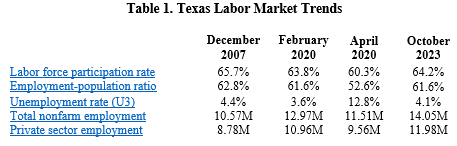 The labor market declined last month continuing a weakening trend in Texas.
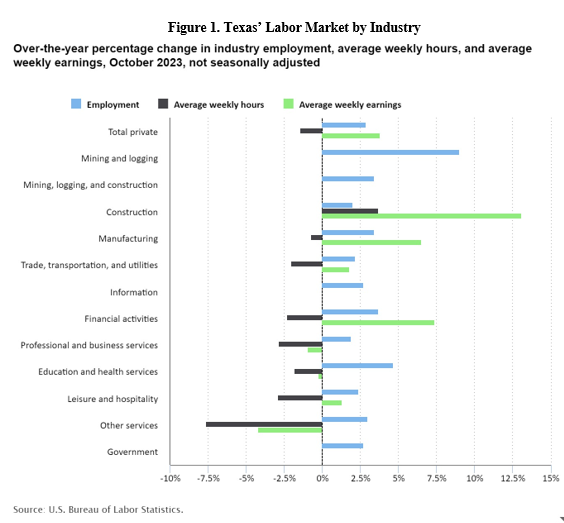
The economy continues to expand in Texas though there are headwinds.
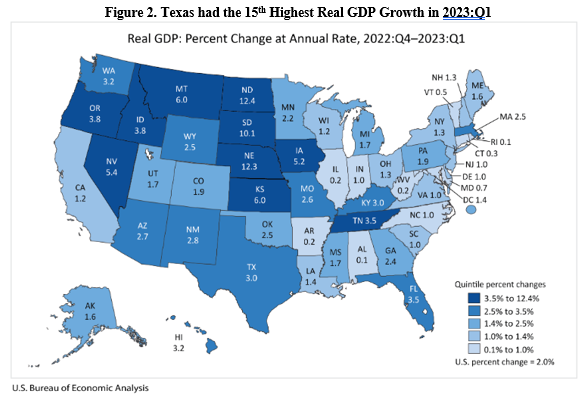
As Texans face an affordability crisis from high inflation and high property taxes and an uncertain future with the U.S. economy likely in a deepening recession, the Legislature provided some tax relief but not nearly enough because of excessive spending.
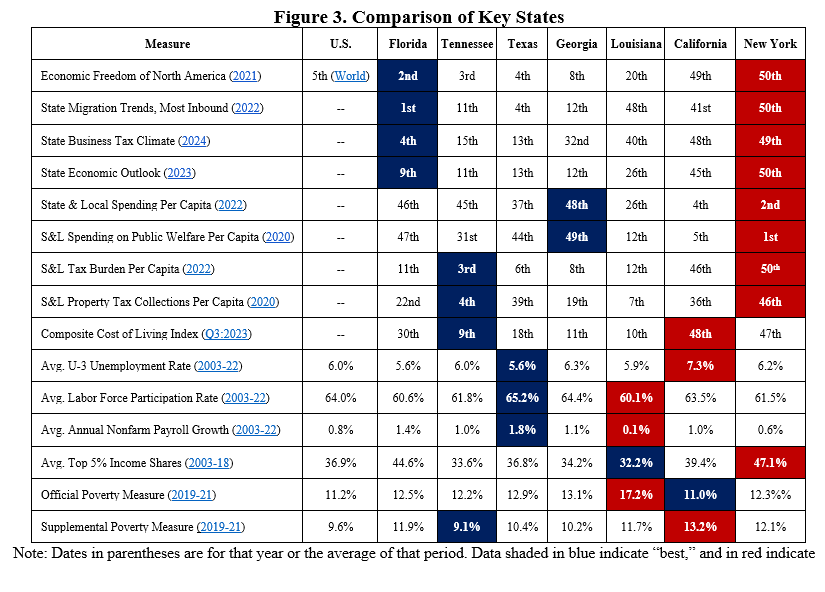
Strengthening the Texas Model will help Texans better resist D.C.’s overreach, be more competitive with other states, and, more importantly, flourish more for generations to come. Don’t miss episode 71 of the Let People Prosper show with Dr. Norman Horn, president of the Libertarian Christian Institute and co-author of “Faith Seeking Freedom.”
We consider controversial questions to help Christians understand how to glorify God in the marketplace. Dr. Horn and I discuss the following and more:
 Originally published at Econlib.
President Biden signed a sweeping executive order to “harness” and “keep” artificial intelligence, two words you never want to hear from the government. This new regulation will inhibit Americans’ flourishing because restricting free markets never works. The EO is reported to ensure safety, equity, and responsible development. While these goals may appear laudable, delving deeper reveals that this motion will hinder economic progress and stifle the innovation it aims to promote. That’s why policies must always be judged by their results rather than their intentions. Details of the order’s objectives include safety tests, industry standards, and government oversight to address potential risks associated with AI. Forcing AI companies to conduct safety tests before going public, known as “red teaming,” will significantly slow the development and deployment of AI technologies. It’s well-established that innovation thrives in an environment of minimal regulatory interference called “permissionless innovation.” So introducing these bureaucratic hurdles will hinder fast-growing AI and all the industries that have begun to rely on it. Medicine and biotech, in particular, have realized remarkable potential with AI that has life-saving ramifications. But Biden’s overreaching EO wants to harness that. As is the case with many regulations, the EO comes at not just a cost to the individuals it affects but to the government’s pocketbook as well. As part of its endeavor to “preserve individuals’ privacy,” the administration will fund the Research Coordination Network. At a time when wages aren’t keeping pace with inflation and the average American family is losing real money due to a suffering economy, the government adding an expense like this is an insult to injury. Congress needs to reduce spending, and the Fed needs to slash its bloated balance sheet now more than ever. One of the most troubling aspects of the EO is its emphasis on regulating AI in the workforce out of concern for the technology displacing workers. Although there has been some uproar out of concern over AI destroying jobs, research shows that only 34% of Americans fear job displacement due to AI. And for good reason. Not only now but historically, concerns about new technologies displacing workers have been overblown. A Harvard paper published in 2013 predicted that by 2023, almost half of all American jobs would be replaced by AI. Clearly, the calculation has not come to pass. That’s because technology is a tool, not a threat. Frequently, implementing AI and technology like it allows humans to do more complex or human-facing jobs that AI can’t do or that people don’t want AI to do. AI is a transformative technology that has the potential to revolutionize various industries, from healthcare to finance and beyond. In a free market, competition drives innovation and efficiency, benefiting consumers and businesses. Restricting AI through excessive regulations and government oversight threatens this dynamic. While the intention behind Biden’s EO on AI may be to ensure responsible development and safe use, the economic consequences could be dire. To maintain America’s leadership in AI and foster economic growth, lawmakers and leaders must avoid overregulation and unnecessary restrictions on this transformative technology. Instead, we should encourage innovation, protect intellectual property, and ensure that AI remains a powerful tool for driving economic prosperity and improving the lives of all Americans. In the fast-paced world of technology, the last thing we need is government interference that hampers progress.  President Biden signed a sweeping executive order to “harness” and “keep” artificial intelligence, two words you never want to hear from the government. This new regulation will inhibit Americans’ flourishing because restricting free markets never works.
The EO is reported to ensure safety, equity, and responsible development. While these goals may appear laudable, delving deeper reveals that this motion will hinder economic progress and stifle the innovation it aims to promote. That’s why policies must always be judged by their results rather than their intentions. Details of the order’s objectives include safety tests, industry standards, and government oversight to address potential risks associated with AI. Forcing AI companies to conduct safety tests before going public, known as “red teaming,” will significantly slow the development and deployment of AI technologies. It’s well-established that innovation thrives in an environment of minimal regulatory interference called “permissionless innovation.” So introducing these bureaucratic hurdles will hinder fast-growing AI and all the industries that have begun to rely on it. Medicine and biotech, in particular, have realized remarkable potential with AI that has life-saving ramifications. But Biden’s overreaching EO wants to harness that. As is the case with many regulations, the EO comes at not just a cost to the individuals it affects but to the government’s pocketbook as well. As part of its endeavor to “preserve individuals’ privacy,” the administration will fund the Research Coordination Network. At a time when wages aren’t keeping pace with inflation and the average American family is losing real money due to a suffering economy, the government adding an expense like this is an insult to injury. Congress needs to reduce spending, and the Fed needs to slash its bloated balance sheet now more than ever. One of the most troubling aspects of the EO is its emphasis on regulating AI in the workforce out of concern for the technology displacing workers. Although there has been some uproar out of concern over AI destroying jobs, research shows that only 34% of Americans fear job displacement due to AI. And for good reason. Not only now but historically, concerns about new technologies displacing workers have been overblown. A Harvard paper published in 2013 predicted that by 2023, almost half of all American jobs would be replaced by AI. Clearly, the calculation has not come to pass. That’s because technology is a tool, not a threat. Frequently, implementing AI and technology like it allows humans to do more complex or human-facing jobs that AI can’t do or that people don’t want AI to do. AI is a transformative technology that has the potential to revolutionize various industries, from healthcare to finance and beyond. In a free market, competition drives innovation and efficiency, benefiting consumers and businesses. Restricting AI through excessive regulations and government oversight threatens this dynamic. While the intention behind Biden’s EO on AI may be to ensure responsible development and safe use, the economic consequences could be dire. To maintain America’s leadership in AI and foster economic growth, lawmakers and leaders must avoid overregulation and unnecessary restrictions on this transformative technology. Instead, we should encourage innovation, protect intellectual property, and ensure that AI remains a powerful tool for driving economic prosperity and improving the lives of all Americans. In the fast-paced world of technology, the last thing we need is government interference that hampers progress. Originally published at Econlib. Today, I cover:
 New Hampshire has displaced Florida as the most economically free state, according to the Fraser Institute’s new Economic Freedom of North America report. The findings demonstrate that, while size and location account for some of a state’s success, free-market friendliness is everything.
This annual report, now in its nineteenth edition (one of us is its lead author), offers a comprehensive analysis of economic freedom using 2021 data (the most recent available). The report defines economic freedom as “the ability of individuals to act in the economic sphere free of undue restrictions.” The top five states in the report are what one might expect. Unsurprisingly, these top five states tend to spend less, do not have a personal income tax, and have reasonable labor market regulations. New Hampshire improved its economic freedom score from 7.92 to 7.96 to retake the top spot after losing it in the prior year. Florida fell from the top as it dropped from 7.97 to 7.80. Tennessee declined from 7.85 to 7.73 for third place. Texas inched down from 7.67 to 7.64, and South Dakota fell from 7.73 to 7.59. Conversely, the least economically free states were New York (4.09), California (4.27), Vermont (4.27), Oregon (4.56), and Hawaii (4.58), all of which lost ground since the last report. Each state has some of the highest rates of taxation and government spending, as well as stringent labor market regulations. In the freest quartile of states, the population grew on average by one percent in 2022, compared to a 0.1 percent decline in the least free quartile. Americans are voting with their feet in favor of economic freedom, fueling the flood of California and New York refugees pouring into Texas and Florida. Furthermore, hundreds of research papers have used the index, almost universally finding that more economic freedom correlates with positive outcomes such as higher incomes, faster income growth, lower unemployment, and more entrepreneurial activity. Bluntly, states with less government spending, lower taxes, and less burdensome labor market regulations have more opportunities for people to flourish. While the report has many compelling findings, two states stand out: New Hampshire and South Dakota. New Hampshire has embarked on a journey of economic liberation in recent years. In 2021, the state had significantly reduced taxes and had begun its ongoing quest to abolish interest and dividends taxes, a huge step toward reducing the tax burden. While the state’s taxes are already relatively low, they continue to decline. New Hampshire does not have a state minimum wage, reducing labor market regulations allowing wages to be market-determined instead of government-mandated. This helps attract young people and others with less experience, training, or education. As a result, household incomes in the Granite State are among the highest in America. Consistently, states with low minimum wages draw more people than average, while states with high minimum wages — California, New York, Illinois — are experiencing out-migration. Not only businesses, but also parents and students in New Hampshire have seen their freedom expand through school choice, which will help improve economic outcomes. In its commitment to providing school choice for all, the state has implemented education freedom accounts. These accounts empower parents to make educational choices that best suit their children’s needs while promoting a competitive schooling landscape that benefits teachers and students. South Dakota, too, has made remarkable strides in economic freedom, which became particularly evident during the challenging times of the COVID-19 pandemic. In 2021, the state was an exemplar of resilience and recovery, boasting the lowest unemployment rate in the country after the pandemic hit. Its output recovered pre-pandemic levels before any other state, with its real GDP growing by nearly five percent. Fortunately, the state never issued stay-at-home orders or mask mandates. Instead, state leadership allowed individuals to make decisions concerning personal health and safety, a common theme that has assisted the state’s flourishing. One key factor contributing to South Dakota’s economic success is its unique tax policies. The state is a rare tax haven with no corporate or personal income taxes and no durational limits on trusts. By allowing families to hold wealth indefinitely within trusts, and letting earners keep more of their hard-won incomes, South Dakota has remained a top spot for entrepreneurs. This tax-friendly environment in South Dakota reaffirms a fundamental economic principle: spending and taxes influence individual choices. As evidenced by the state’s success, people gravitate toward regions with lower tax burdens and more favorable financial policies. The success stories of New Hampshire and South Dakota underscore the power of economic freedom in fostering human flourishing. In a society where consumers are free to choose, businesses must continually improve the quality and affordability of their products and services. This dynamic situation fuels increased productivity and benefits everyone in the economy. Economic freedom isn’t just about lower taxes. It encompasses a broader spectrum of policies that allow individuals to make decisions about their lives, finances, and education. It’s about governments empowering people with opportunities rather than restricting or directing activity. By following New Hampshire and South Dakota’s lead, other states can unleash the power of economic freedom to boost investment, create jobs, improve human flourishing, and make their regions more competitive and attractive places to live. In a world where economic challenges are ever-present, these states serve as beacons of hope, proving that less government spending, lower taxes, and reduced labor market regulations can pave the way to a brighter economic future, full of greater opportunity for all. Originally published at Daily Caller.  Originally published at American Institute for Economic Research.
The rise of several underdog states and the fall of previous favorites tells the story of the Tax Foundation’s new 2024 State Business Tax Climate report. The findings support how less government contributes to more flourishing, while heavy-handed taxes hinder prosperity. The scores for the 50 states in the report declined by 0.19 points from the prior report, indicating a less overall competitive business tax climate nationwide. Considering that half of all states have cut taxes over the past three years, and an increasing number are moving to flax taxes, pressure is building on states to seek tax cuts or risk getting left behind. An inspiring success story is Iowa, which has emerged as a beacon of pro-growth tax reform. Iowa reduced its top marginal individual income tax rate from 8.53 to 6.0 percent. By consolidating its previous nine tax brackets into four, the newer, more streamlined tax system is less burdensome for Iowans. Another improvement in Iowa’s reforms was reducing the marriage penalty. The state removed a longstanding tax burden by doubling the bracket amounts for married couples filing jointly. The state also shifted its previously three-bracket corporate income tax structure into just two brackets, which caused the top rate to drop by 1.4 percentage points. As a result of these changes, Iowa’s ranking improved from 38th to 33rd in just one year. While there’s room for improvement, the state is on a better path. Considering the conservative budgeting by Governor Reynolds and the legislature, and the transition to a flat 3.9 percent income tax rate by 2026 and a flat corporate income tax rate of 5.5 percent, the state could soon be on its way to 15th place. Massachusetts, on the other hand, experienced the sharpest decline of all the states, plummeting 12 places down to 46th. This regression in business tax competitiveness can be largely attributed to a new state constitutional amendment. It transitioned Massachusetts from a single-rate to a graduated-rate income tax system with a new 4 percent surtax for a top marginal tax rate of 9 percent for incomes over $1 million. This progressive policy not only represents a departure from the trend of rate reductions and bracket consolidation in other states as part of the flat tax revolution, but also introduces a significant marriage penalty. While implementing a new payroll tax further contributed to Massachusetts’s decline in tax competitiveness, the state’s individual tax component ranking fell from 11th to 44th. Unfortunately, this fall was foretold by the vast number of people fleeing the state, many of whom were no doubt searching for a more tax-friendly place of residence. After all, people vote with their feet. While Massachusetts experienced a sharp fall, Mississippi and Idaho emerged as rising stars in the world of tax reform. Mississippi’s ranking jumped from 27th to 20th thanks to three major shifts. It became the second state to implement permanent full expensing for select investment in machinery and equipment, passed a flat personal income tax, and will soon phase out its franchise tax. These forward-thinking policy changes encourage investment and economic growth, positioning Mississippi as a more competitive business destination. Likewise, Oklahoma has also made significant strides in tax reform. In addition to eliminating its marriage penalty, the state reduced its split roll ratio in property taxation and withdrew its capital stock tax. These actions propelled its property tax component ranking to substantially improve from 30th to 15th. As a result of these reforms, Oklahoma’s overall ranking has risen significantly, now at 19th. And while Governor Stitt’s recent special session was unsuccessful in making bigger strides for tax cuts, the state looks poised to do so soon, thereby improving its competitiveness. On a similar path, Idaho made a noteworthy move by transitioning from four brackets to a flat individual income tax at 5.8 percent. Additionally, the state cut its corporate income tax rate to 5.8 percent, further enhancing its tax competitiveness. These reforms boosted its individual tax component rank by two places, now at 17th. The findings from the Tax Foundation’s report underscore a fundamental economic truth: Free markets do not discriminate. They thrive where they are permitted to flourish, and that starts with sustainable budgeting and sound tax policy. States like Iowa, Oklahoma, Mississippi, and Idaho, which prioritize tax cuts and financial freedom, are poised to rise in the rankings and could quickly become some of the more sought-after states. As they continue to reduce tax burdens, they create environments where individuals and businesses can retain more of their earnings, which invites innovation, improves the quality of life, and encourages moving to those states. Meanwhile, states like Massachusetts and New Jersey, which ranks 50th in the report, choose high spending and taxes that will contribute to continued out-migration as individuals and businesses seek refuge in states prioritizing economic freedom. The message is unmistakable. Free markets work, and policymakers should heed the lessons from these tax climate rankings. There’s much to every person’s journey. Mine has many cycles that made me the man I am today. The video above and the document below tells my story of a key cycle that highlights a peak, trough, and subsequent peak on the anniversary of this life-changing event. I've included pictures throughout that will hopefully give you a good perspective. Moral of the story: Even “rockstars” can make a difference! #LetPeopleProsper  The rise of several underdog states and the fall of previous favorites tells the story of the Tax Foundation’s new 2024 State Business Tax Climate report. The findings support how less government contributes to more flourishing, while heavy-handed taxes hinder prosperity.
The scores for the 50 states in the report declined by 0.19 points from the prior report, indicating a less overall competitive business tax climate nationwide. Considering that half of all states have cut taxes over the past three years, and an increasing number are moving to flax taxes, pressure is building on states to seek tax cuts or risk getting left behind. An inspiring success story is Iowa, which has emerged as a beacon of pro-growth tax reform. Iowa reduced its top marginalindividual income tax rate from 8.53 to 6.0 percent. By consolidating its previous nine tax brackets into four, the newer, more streamlined tax system is less burdensome for Iowans. Another improvement in Iowa’s reforms was reducing the marriage penalty. The state removed a longstanding tax burden by doubling the bracket amounts for married couples filing jointly. The state also shifted its previously three-bracket corporate income tax structure into just two brackets, which caused the top rate to drop by 1.4 percentage points. As a result of these changes, Iowa’s ranking improved from 38th to 33rd in just one year. While there’s room for improvement, the state is on a better path. Considering the conservative budgeting by Governor Reynolds and the legislature, and the transition to a flat 3.9 percent income tax rate by 2026 and a flat corporate income tax rate of 5.5 percent, the state could soon be on its way to 15th place. Massachusetts, on the other hand, experienced the sharpest decline of all the states, plummeting 12 places down to 46th. This regression in business tax competitiveness can be largely attributed to a new state constitutional amendment. It transitioned Massachusetts from a single-rate to a graduated-rate income tax system with a new 4 percent surtax for a top marginal tax rate of 9 percent for incomes over $1 million. This progressive policy not only represents a departure from the trend of rate reductions and bracket consolidation in other states as part of the flat tax revolution, but also introduces a significant marriage penalty. While implementing a new payroll tax further contributed to Massachusetts’s decline in tax competitiveness, the state’s individual tax component ranking fell from 11th to 44th. Unfortunately, this fall was foretold by the vast number of people fleeing the state, many of whom were no doubt searching for a more tax-friendly place of residence. After all, people vote with their feet. While Massachusetts experienced a sharp fall, Mississippi and Idaho emerged as rising stars in the world of tax reform. Mississippi’s ranking jumped from 27th to 20th thanks to three major shifts. It became the second state to implement permanent full expensing for select investment in machinery and equipment, passed a flat personal income tax, and will soon phase out its franchise tax. These forward-thinking policy changes encourage investment and economic growth, positioning Mississippi as a more competitive business destination. Likewise, Oklahoma has also made significant strides in tax reform. In addition to eliminating its marriage penalty, the state reduced its split roll ratio in property taxation and withdrew its capital stock tax. These actions propelled its property tax component ranking to substantially improve from 30th to 15th. As a result of these reforms, Oklahoma’s overall ranking has risen significantly, now at 19th. And while Governor Stitt’s recent special session was unsuccessful in making bigger strides for tax cuts, the state looks poised to do so soon, thereby improving its competitiveness. On a similar path, Idaho made a noteworthy move by transitioning from four brackets to a flat individual income tax at 5.8 percent. Additionally, the state cut its corporate income tax rate to 5.8 percent, further enhancing its tax competitiveness. These reforms boosted its individual tax component rank by two places, now at 17th. The findings from the Tax Foundation’s report underscore a fundamental economic truth: Free markets do not discriminate. They thrive where they are permitted to flourish, and that starts with sustainable budgeting and sound tax policy. States like Iowa, Oklahoma, Mississippi, and Idaho, which prioritize tax cuts and financial freedom, are poised to rise in the rankings and could quickly become some of the more sought-after states. As they continue to reduce tax burdens, they create environments where individuals and businesses can retain more of their earnings, which invites innovation, improves the quality of life, and encourages moving to those states. Meanwhile, states like Massachusetts and New Jersey, which ranks 50th in the report, choose high spending and taxes that will contribute to continued out-migration as individuals and businesses seek refuge in states prioritizing economic freedom. The message is unmistakable. Free markets work, and policymakers should heed the lessons from these tax climate rankings. Originally published at AIER. Don’t miss episode 70 of the Let People Prosper Show podcast with guest Pete Sepp, president of the National Taxpayers Union.
We discuss the key issues facing AI, technology, and many others. While we recorded this before Biden’s latest executive order regulating AI, we hit on many reasons why we should reject this approach. I am discouraged by President Biden’s new executive order that aims to “harness” artificial intelligence. Pete and I discuss:
Full show notes here. The 34th episode of "This Week's Economy” includes a brief real of the latest news with President Biden's new EO on AI, Sam Bankman-Fried's guilty verdict, Texas Property Taxes, and more.
Tuesday was Election Day. I voted early last week and found it pleasing to vote down all of the junk politicians throw our way. We must see through desire to be re-elected so we can get better policy and results. Today, I cover:
Full show notes here. Today, I'm joined on episode 68 of the "Let People Prosper" show by Dr. Carlos Carvalho who is a Professor in Statistics at the University of Texas-Austin and Director of the Salem Center.
Please like this video, subscribe to the channel, share it on social media, and provide a rating and review. Also, subscribe and see show notes for this episode on Substack (www.vanceginn.substack.com) and visit my website for economic insights (www.vanceginn.com). We discuss: 1) Economic lessons that Dr. Carvalho learned living in Brazil during the 80s while the nation suffered from hyperinflation and how it relates to current overspending by Congress in the U.S. (see more on this in my episode with Dr. John Cochrane); 2) The importance of federalism and letting markets work; and 3) How the pandemic was mishandled and the importance of understanding tradeoffs. Today, I cover:
  Be sure to check out and subscribe to the "Human ReAction" podcast.
We discuss the following and more:
 Our new report highlights Louisiana’s economic situation based on the most recent data. The report is based on several key factors that indicate how the economy, labor market, and public policy influence the lives of everyday Louisianans. While some of these data indicate a relatively strong labor market–such as the historically low unemployment rate–there are underlying factors showing Louisiana’s economic struggle. Our Louisiana Comeback will happen through reforms that remove government barriers, bring jobs and opportunity back to Louisiana, and let people prosper. We must decide: Will we continue to hold on to the status quo (which hasn’t done us any favors), or will we embrace the significant reforms necessary to bring jobs and opportunity to Louisiana? We need the latter. Read the full two-pager: Economic Report Oct 2023 Originally published by Pelican Institute.  At first glance, you might think that Louisiana’s economy is doing great. After all, the state’s September 2023 jobs report shows record lows for the unemployment rate at 3.3% and and people unemployed at 67,930. Louisiana Governor John Bel Edwards cheered these data in a press release: “Louisiana continues to set records for low unemployment. We’ve had 30 consecutive months of job growth and have added nearly 280,000 jobs since the worst of the pandemic. In fact, our employment levels are now higher than they were before COVID. Experts believe that our bipartisan work to grow and diversify our economy will benefit Louisiana for years to come. Economist Dr. Loren Scott recently predicted that Louisiana will add more than 80,000 jobs over the next two years. And we’ve done it all while overcoming historic natural disasters and a state government budget crisis. I have never been more optimistic about Louisiana than I am today.” But does what you hear in the media or by some politicians match reality? Let’s dive into the data to see how things are going for Louisianans. We should know that the Pelican State has many fantastic resources but too many failed public policies that keep Louisianans from reaching their full potential. This has been the case for a while, but most recently, the jobs reports indicate slowing employment growth and a declining labor force. Work matters, as it brings about dignity and self-sufficiency and leaves fewer people needing help from government safety net programs. These data below show that while the labor market data can look good on the surface, there are many real problems facing Louisianans that need to be addressed by state leaders. Fortunately, the Pelican Institute’s “Comeback Agenda,” including our fiscal reform plan, supports ways to overcome these challenges. Here are key issues in Louisiana’s economy. Table 1 provides Louisiana’s labor market data for important dates from the U.S. Bureau of Labor Statistics. These dates are December 2007, when the Great Recession started; February 2020, when the last expansion peaked before the COVID-19-related shutdowns; April 2020, when the shutdown recession ended; and September 2023, for the latest data available. 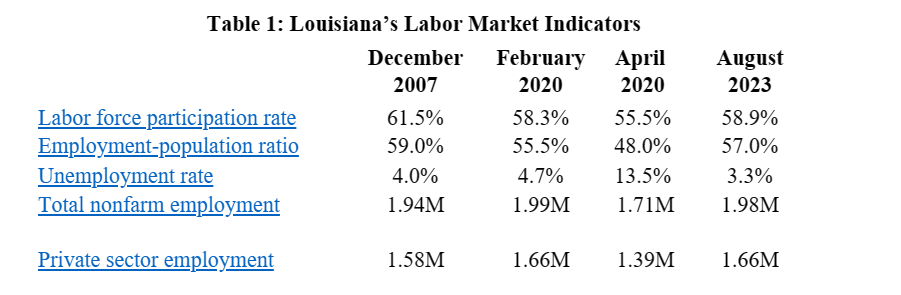 The unemployment rate would be 4.9% if Louisianans hadn’t left the state since pre-COVID. The unemployment rate is calculated using data from the household survey and isn’t a great measure of the labor market. This is because unemployment in the numerator and the labor force in the denominator are volatile measures as people enter and exit Louisiana and the labor force. Considering data from pre-COVID to compare with the Governor’s statement, the working-age population is down by 36,329 to 3.5 million. Even though the labor force is up 1,566 since then, the many people who have left the state keep the unemployment rate lower than otherwise. If we include the departed population in the labor force and unemployment, the unemployment rate would be 4.9%, substantially higher than the reported 3.3%. Moreover, if the working-age population hadn’t declined, the labor force participation rate would be 59.3% instead of the 58.9% rate today. Louisiana’s employment has not increased for 30 consecutive months. While the Governor is correct that there have been about 280,000 jobs since pre-COVID, there have not been “30 consecutive months of job growth.” The payroll survey shows that nonfarm employment is up 270,300 and the household survey shows that employment is up 295,065 since February 2020. There was an increase in nonfarm employment by 8,900 jobs in September (6th most in percentage terms of any state). But this was after cumulative losses of 3,600 jobs during June and July for an increase of just 18,100 jobs over the last four months. Over the last 30 months, there have been seven months with declining net jobs in the payroll survey and nine months with declines in the household survey, which has had four straight months of declines for a total of 17,564 fewer people employed in that period. So, Louisianans have actually been struggling over the last 30 months. Louisiana will add a projected 80,000 more jobs over the next two years, indicating slower job creation. Considering nonfarm employment over a longer period, it is up by 46,000 jobs from a year ago (20th most in the country) for a 2.4% increase (12th fastest). This would result in 92,000 jobs added over the next two years if this pace continued, but the Governor says one projection is just 80,000 jobs added over that period, indicating slower job creation. Also, nonfarm employment is down by 13,700 jobs since February 2020 (one of only a few states that have not regained lost jobs since then). Jobs in the private sector increased by 520 last month to 1.66 million, and government employment increased by 8,300 jobs to 320,500. There is growing weakness in the labor market, with some job losses and average weekly earnings not rising as fast as CPI inflation of 3.7% in many industries (Figure 1). 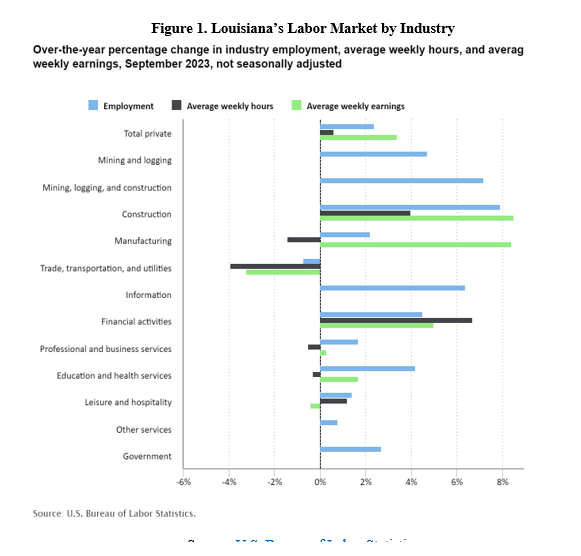 Another weakness is economic growth. Table 2 shows how the U.S. and Louisiana economies performed since 2020, as reported by the U.S. Bureau of Economic Analysis. 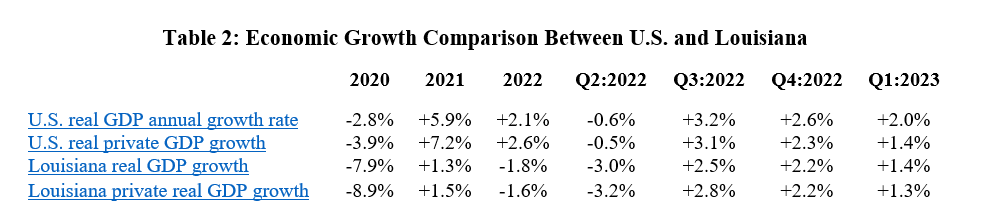 The steep declines were during the shutdowns in 2020 in response to the COVID-19 pandemic, which was when the labor market suffered most. Figure 2 shows how the increase in real GDP in Louisiana of +1.4% in Q1:2023 ranked 31st in the country to $289.9 billion, after an annual decline in economic output by -1.8% in 2022 which was the second worst in the country. 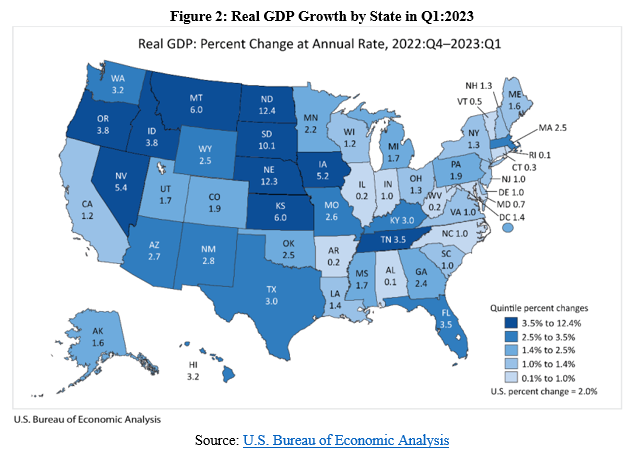 The BEA also reported that personal income in Louisiana grew at an annualized pace of +6.2% (ranked 27th) to $258.5 billion in Q1:2023 (above +5.1% U.S. average). There was personal income growth of 0.0% in 2022, ranking 50th of the states. Compared with neighboring states based on several measures there continue to be major concerns in Louisiana (see Table 3). 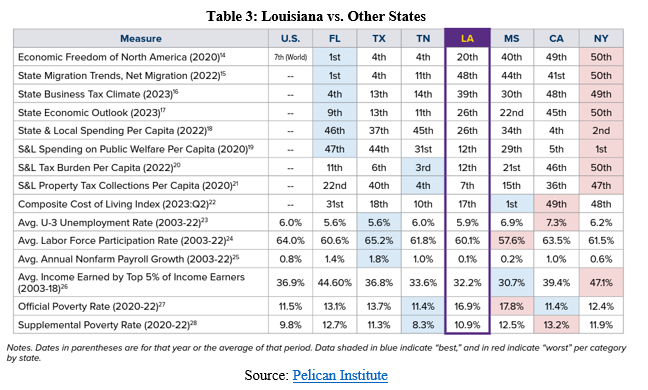 Bottom Line: Louisiana’s economy is weak when it comes to the labor market and economic growth and when compared with other states. Bold, transformational reforms can unleash the potential of Louisianans and make the state more competitive.
Originally published at Pelican Institute. |
Vance Ginn, Ph.D.
|

 RSS Feed
Proudly powered by Weebly