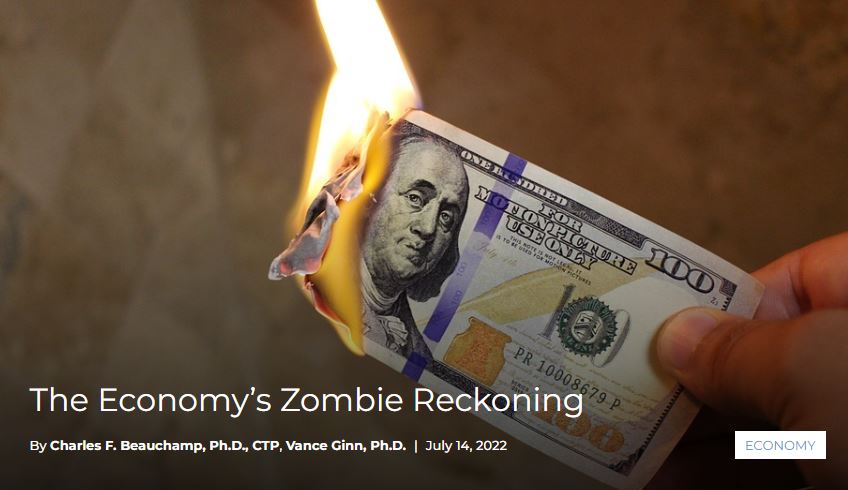
 Only a bolt of lightning or a dose of radiation can awaken zombies in the movies; the same isn’t true for an economic zombie. In the latter’s case, it took many years—especially the last two years—of deficit-spending fueling excessive money printing to get this day of reckoning for the U.S. economy with frequent mentions of “stagflation” and “recession.”
An economic zombie is harder to kill than in the movies, as they last as long as the policies that raised them, causing much avoidable pain to Americans—especially to those who can least afford it. Bad policies must stop so this scary movie disrupting our lives ends. Zombie firms are those that are fragile as debt mainly funds their operations. They rose in the U.S. since 2008 as the Federal Reserve held interest rates too low for too long and Congress passed numerous bailouts and spending packages. Congress’ recent actions of even worse deficit-spending packages that led to a 20% increase in the national debt since January 2020 to a whopping $30.5 trillion—or $90,000 owed per American—helped prop up many more zombie firms. Thankfully, the Fed is finally fighting the 40-year high inflation rate by (slightly) reducing its balance sheet to raise its federal funds rate target. But it’s well-behind the curve as it should be tightening much faster according to the well-respected Taylor rule. It’s also good news that Congress doesn’t look poised to pass any more reckless deficit-spending packages—thanks to Senate Republicans, Democratic Sen. Joe Manchin, and Sen. Kyrsten Sinema—but a new attempt is brewing. When these bad policies stop, there will be a correction of these government failures that created zombie firms to turn to dust. Evidence of this is small businesses—which are the most sensitive to these escalating costs—cutting 91,000 jobs in May, making it three out of four months with job losses at small businesses. And according to a recent WSJ survey, six out of ten small-business owners expect the economy to be worse in the next year, matching the record low in April 2020. Dying zombie firms will put downward pressure on labor markets as they cut workers and drop open positions to stem higher costs, which will reduce the inflated number of job openings exceeding unemployed workers. With so many workers not looking for a job, there are also many zombie workers. Millions of workers haven’t returned since the recession and others are jumping from one job to another to keep up with rapidly rising inflation and to find the “best” match. The handouts without work requirements—such as “stimulus” checks, child tax credit payments, and expanded Medicaid over the last two years—contributed to this situation as the personal savings rate jumped to a historic high of 33% in April 2020 and stayed elevated for a while. But now that rate is dropping like it’s hot, as people are running through their savings—with the latest rate of 5.4% in May 2022 being the lowest in nearly 14 years. If zombie firms begin to crumble and zombie workers don’t search for a job, the resulting zombie economy will hit a wall. The result will be a rising unemployment rate, soaring inflation, and stagnating economy, which would extend this costly period of stagflation. This weakens President Biden’s argument that the strength of the labor market can mitigate the effects of inflation, as inflation-adjusted hourly earnings remain negative. The Fed is way behind the inflationary curve, and it’s the primary entity that can correct this walking dead inflation situation. Instead of blaming “corporate greed” or “Putin’s price hikes,” President Biden, Congress, and the Fed must cut regulations, spend and tax less, and print less money. The zombie economy’s reckoning is likely a recession with real GDP declines of in the first quarter and another likely decline in the second quarter. No wonder President Biden’s approval rating is hitting record lows and his disapproval rating hitting record highs. To awaken the zombie economy, there needs to be responsible fiscal and monetary policies in Washington. This includes pro-growth spending, regulating, and taxing reductions to support expanding supply and aggressive quantitative tightening to deflate demand. Until then, the zombie economy will continue to bring deeper, longer-lasting pain. Published at TPPF with Charles Beauchamp  The fact that our nation’s unemployment rate is approaching the low rate of 3.5% that was reached just prior to the pandemic should be a cause for celebration. But for a variety of reasons, the official unemployment number is misleading.
The employment situation is not as rosy as it may seem. There is a wide disparity among the states that can be explained by how much economic freedom they allow, including how severely each state shut down its economy due to the COVID-19 pandemic. Consider that the U.S. remains 1.6 million jobs short of our February 2020 high, just before the pandemic came to our shores. Since then, our population has grown by 3.8 million people but the labor force shrank by 174,000 workers. The picture diverges for states. As demonstrated in our 2021 study, the states with the worst job recovery also imposed the harshest COVID-19 measures. For example, two states with the severest lockdowns — California and New York — are also experiencing two of the worst job recoveries, with unemployment rates at least a full percentage point above the national average of 3.6% based on the newly released March 2022 data. Conversely, Utah and Nebraska, who are among the states with the least severe lockdown policies, are tied with the lowest unemployment rate of 2.0%, well below the national average. In measuring how states have rebounded, a better metric than the unemployment rate is the recovery in private employment. Only 16 states have recovered all the private jobs lost due to the shutdowns compared to February 2020. But if we account for each state’s pre-pandemic job growth trajectory, our analysis shows that Montana and Utah stand above the rest for exceeding our forecast of their private employment. Idaho follows closely behind Montana and Utah, and then Wyoming, North Carolina, Mississippi, South Dakota, Arkansas, Maine, and Georgia to round out the top 10 performing states. Except for Maine and North Carolina, each one has a Republican trifecta (GOP controls both chambers of the legislature and the governor’s office). North Carolina leans Republican, and Maine is the anomaly having a Democrat trifecta. What about the bottom 10 states in private-sector jobs recovery? They are Hawaii, New York, North Dakota, California, Maryland, Vermont, Minnesota, Oregon, Massachusetts, and Louisiana. Four of those have Democrat trifectas and four lean Democrat. Louisiana, the last state to make the bottom 10, leans Republican. North Dakota — a Republican trifecta that had one of the least restrictive COVID policies — is a special case due to an unusual economic situation. Its pre-pandemic job growth numbers differed from all other states, and it also relies more heavily on mining and petroleum than any other state. Its petroleum industry went bust in 2014, causing private employment to peak in December 2014 that finally bottomed out in January 2017. Since then, its private job growth has been slow, less than 1% per year. President Biden’s anti-fossil fuels executive orders, including the cancellation of the Keystone XL Pipeline, have only made matters worse for North Dakota. Putting this outlier aside, what accounts for this dramatic difference in recoveries between red and blue states? As already indicated, Republican governors were less severe with their lockdown policies. For another, all Republican governors (with the exception of Louisiana) ended supplemental unemployment payments before they were set to expire last September. These payments contributed to some people receiving more than they would have had they been working. In fact, one study finds that those states that didn’t end these payments early contributed to 3 million fewer people in the labor force. Underlying the difference is likely the extent of economic freedom in each state. Using the Economic Freedom of North America 2021 report published by the Fraser Institute, which is based on 2019 data, the top 17 states allowing for the most economic freedom either lean Republican or have Republican trifectas. In fact, 14 of them are the trifectas. Eight of the bottom 10 have Democrat trifectas, with New York leading the pack, followed by California. The other two in the bottom 10 include Vermont that leans Democrat and West Virginia with a Republican trifecta. The best path to prosperity is a job. Work brings dignity, hope, and purpose to people by allowing them to earn a living, gain skills, and build social capital that endures. Advancing policies that connect people with work, along with reducing barriers for new jobs and opportunities, should be our goal, rather than making a government the first resort for help that disconnects people from what work brings. The red states are showing the way to achieve this sound policy. Other states should follow while things at the federal level look bleak. But as our founders desired, the system of federalism that breeds a laboratory of competition helps shed light on what works best to let people prosper. https://www.texaspolicy.com/economically-free-states-are-recovering-rapidly-high-control-states-not-so-much/  An MSNBC headline reporting on a recent interview of a White House economic advisor Jared Bernstein claimed that America has a “booming economy.” But that’s not what most Americans think about the economic situation.
The University of Michigan’s consumer sentiment index for March, which gauges how consumers feel about the economy, fell to a decade low at 59.4. This is a 5.4% drop from February and a 30% drop from March 2021. The survey reveals Americans’ pessimism and uncertainty amidst the highest levels of inflation since the 1980s. Many Americans reported that they have had to reduce their quality of life and lower their living standards amidst the inflation crisis. This crisis has been created by the Federal Reserve printing too much money to fund the overspending by Congress, and exacerbated by the Biden administration’s war against oil and gas that fueled higher energy prices and have been amplified by the Russia-Ukraine conflict. The only positive news from the survey was slight optimism for the strengthening labor market. Survey statistics revealed that there was hope that the unemployment rate would continue to decline. While there are reasons to be optimistic about the labor market’s increase in monthly nonfarm jobs—431,000 (with 426,000 in the private sector)—and the unemployment rate dropping to 3.6%, weaknesses remain. For example, since the shutdown recession ended in April 2020, total nonfarm jobs are up 20.4 million but are still down 1.6 million from February 2020. This indicates that though the labor market is improving, but it’s not as strong as it was then. And while the Biden administration touts the jobs created since he took office in January 2021, only 39% have been added since then while the other 61% were during the Trump administration. Other unaddressed labor market weaknesses remain. Inflation-adjusted wages are down by 2.3% over the last year, a depressed prime-age (25-54 years old) employment-population ratio by 0.5 percentage point since February 2020, and a broader U6 underemployment rate of 6.9%. Further adding to the concern in the labor market is a record high of 5 million more unfilled jobs (11.3 million) than unemployed people (6.3 million). These ongoing weaknesses are shedding light on the impacts of big-government policies out of D.C., such as the “stimulus” checks, enhanced unemployment insurance, expanded child tax credits, and pandemic-related mandates, that have limited and are hindering the rebound of the American economy. Instead, we must return to normalcy if we wish to give Americans more opportunities to prosper. But that’s not happening. Paired with the inflation we’re dealing with stagnating economic growth, creating a period of stagflation for the first time since the 1970s. Rising inflation is foreshadowing concerns of a future recession and economic crisis as American families are paying substantially more for products and services amidst reduced purchasing power. Why is our economy out of control, and what can be done to mitigate the economic crisis? The government imposed a “shutdown recession” from March to April 2020 that proved devastating. Amidst the shutdown, elected officials heightened Americans’ economic dependence on government through $6 trillion in deficit-spending that included programs which disincentivized working. Two years later, there must be a return to the dignity and permanent value of work — instead of the dependence on the government that the Biden administration is promoting. For example, the Biden administration’s irresponsible proposed budget of $5.8 trillion includes massive spending while raising and creating harmful taxes, such as the new “billionaire tax” that Sen. Joe Manchin already shot down. The result of this irresponsible budget would be an increase in the debt by 50% to $45 trillion over the next decade, which is highly optimistic given their unlikely rosy economic assumptions. Given the likelihood of continued trillion-dollar deficits for the foreseeable future and the Fed keeping its target overnight lending rate low even as it raises the rate by printing more money means that more inflation and economic damage are to come. But this doesn’t have to happen. Congress should choose a different path, enacting pro-growth policies like those passed from 2017 to 2019, which will better provide Americans with opportunities to improve their lives and livelihoods. This should be paired with binding fiscal and monetary rules to stop Congress from overspending hard-earned taxpayer dollars and to stop the Fed from overprinting money that’s reducing families’ purchasing power. We should stop the “booming economy” rhetoric and focus on how families are doing. The way to give them more opportunities to flourish is by removing obstacles imposed by government. https://www.texaspolicy.com/booming-economy-not-if-you-ask-most-americans/  There’s new evidence government-imposed shutdowns prompted by the COVID-19 pandemic have done more harm than good. Instead, a better choice is keeping the economy open so people stay connected to work and targeting resources to vulnerable populations.
A new meta-analysis from Johns Hopkins University underscores this finding, revealing that lockdowns in America and Europe during the first pandemic wave in spring 2020 only reduced the death rate by 0.2% on average. Researchers concluded that lockdowns “have had little to no public health effects” while imposing “enormous economic and social costs” and should be “rejected as a pandemic policy instrument.” While businesses were shuttered, people were forced to stay home, and schools remained closed, the unintended social and economic consequences were clear: Rising unemployment, learning loss among students, spiking rates of domestic violence, and a pandemic-level rise in drug abuse and overdoses. All of that social and economic devastation yielded a minimal impact on health-related suffering due to COVID-19. The new research from Johns Hopkins mirrors our own findings in a recent nationwide study, which found that overreaction by states to waves of the pandemic did substantial damage without much benefit in reducing the effects of the pandemic. The research shows a statistical correlation between how severe state governmental actions were in shutting down their economies and negative impacts on employment more than a year after the pandemic began in America. This was the case even after controlling for a state’s dependence on tourism or agriculture, population density, and the prevalence of COVID-19 infections and hospitalizations. Our research found no correlations between the severity of shutdowns imposed by state governments and the rate of reported COVID-19 hospitalizations or deaths. States like Hawaii, New York, California, and New Mexico that imposed harsher economic restrictions generally have greater job losses even today than those states that were less harsh, such as South Dakota, Iowa, Nebraska, Missouri, and Utah. For example, New York was 10.2% below its trajectory in October 2021 while Nebraska was just 2.4% below. The bottom line is that while policymakers were likely working in good faith to do their best in a challenging situation, it’s crucial we learn from these past mistakes so that we don’t repeat them. And make no mistake about it—those mistakes have driven untold amounts of human suffering during the past two years. The worst part is that the government-imposed shutdowns created even more barriers for people who were already struggling. Every American was impacted, of course. These interventions created challenges and burdens for the middle and upper classes, but for our poorest communities they were outright damaging. Protecting the rights and opportunities of workers to earn a living is obvious. Equally important are the psychological benefits that come with the dignity of work. And there are socio-economic benefits from work that positively impact everyone, such as building social capital and gaining skills, which are especially important for those in marginalized communities who were most impacted by the shutdowns. As the states look for a long-term strategy to deal with the pandemic, it is paramount that they consider the empirical evidence and not impose burdensome restrictions—such as business closures, stay-at-home orders, school closures, gathering restrictions, and capacity limits—on economic activity that have proven to do more harm than good. Instead, the policies need to be crafted more carefully to expand opportunities for the poor and preserve jobs in an open economy in which entrepreneurs can solve problems while taking measures when necessary to protect vulnerable populations. These are the policies that should have been done all along to avoid the severity of the shutdown recession and the effects on lives and livelihoods thereafter. Let’s not make another mistake when so many are already suffering. https://www.texaspolicy.com/lockdowns-were-a-failure-what-we-do-next-doesnt-have-to-be/ 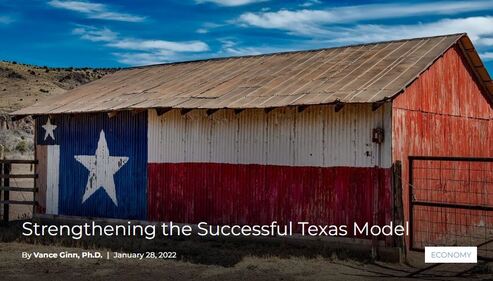 Texas continues to recover from the shutdown recession of 2020. The state has made strong progress toward a full recovery, especially compared to other states. But it has much room for improvement by many metrics before we’ll see the robust pre-shutdown prosperity.
In February 2020, Texas had low unemployment and relatively high labor force participation. The unemployment rate was just 3.7%, which some economists consider to be full employment. That basically means the state’s labor resources were being used as efficiently as possible and there was no cyclical unemployment, which occurs when the economy is in recession or growing too slowly. Likewise, a large portion of the population was participating in the labor market. In February 2020, the labor force participation rate was 64% and the employment-to-population ratio was 61.6%. That then changed drastically with the COVID-19 pandemic and government-imposed shutdowns in March 2020. By April 2020, those numbers had dropped to 60.2% and 52.4%, respectively, the private sector lost 1.4 million jobs (12.8% decline), and the unemployment rate skyrocketed to 12.9%. Since then, Texas has regained its lost private sector jobs, plus another 105,200 jobs, and the unemployment rate is back down to 5%. These data tell an important story about the effect this had on Texans. The best path to prosperity is a job, as work brings dignity and hope to people by allowing them to earn a living, gain skills, and build social capital that endures. Public policy that affects the labor market is so important because it affects people’s livelihoods and their sense of dignity. Last year, the federal government gave extra unemployment payments on top of normal payments. Together, these payments often resulted in recipients receiving more money than they might have made working. This, of course, incentivized them not to work. About half the states, including Texas and mostly red states, rightly ended this program early and those states have been recovering faster than the states which continued the program. The states that discontinued the program before its nationwide expiration in September 2021 have averaged lower unemployment rates. They have also recovered jobs faster, relative to the number of jobs they had before the shutdown recession. Of the 10 states with the highest proportion of private sector employment to pre-pandemic levels, nine are in red states, including Texas. Conversely, six of the 10 states and D.C. with the lowest proportion are in blue places. In general, conservative policies have been more conducive to job growth and overall recovery because they tend to get government out of the way so that people can make the decisions that are best for themselves and their families. Texas is one of just seven states that have recovered all the private sector jobs lost in the shutdown recession. That is an achievement, but the state is still far behind (3% below) the pre-shutdown trend and other measurements of the labor market’s health show that Texas has more work to do. The labor force participation rate is still 1.3 percentage points below its pre-pandemic level, meaning that some people have left the labor market, such as those who have given up looking for work. The employment-to-population ratio is also down 2 percentage points from its pre-pandemic level. It’s important to get these figures back to normal. In November, Texas had 884,000 unfilled job openings and just 770,000 unemployed. That is 114,000 more job openings than workers available to fill them. To fill these jobs, Texas needs more of its people to rejoin the labor market. Achieving that goal starts with responsible government policies. The Texas Model of lower taxes, no personal income tax, less spending, and sensible regulation is necessary to unlock poverty and let people prosper. Texas’ free-market-focused institutions helped the state outpace the national average both in economic growth and income growth in the latest data for the third quarter of 2021. Because the 87th Legislature followed many of the Foundation’s recommendations, especially by passing the strongest spending limit in the nation, these successes for the state and Texans will hopefully continue. But we can do better. Texas can build upon its past success in the upcoming 88th Legislature by further limiting government spending, ensuring opportunities to earn a living, eliminating property taxes, and advancing education freedom. Such efforts will help families flourish, keep Texas Texan, and make Texas the leader for the rest of the nation. https://www.texaspolicy.com/strengthening-the-successful-texas-model/ Texans continue to recover from the shutdown recession. There have been challenges like business closures, skyrocketing local property taxes, and anti-prosperity fiscal and monetary policies out of Washington. Fortunately, the Texas economy was (finally) fully opened on March 10, 2021, and the third wave of COVID-19 is now behind us with better results than after prior waves without statewide mandates of masks, closures, or vaccines—as these should always be voluntary. The 87th Texas Legislature mostly helped support the recovery with passage of many sound policies like a Conservative Texas Budget, a stronger state spending limit, and independent efficiency audits. However, there were missed opportunities like permanent, broad-based property tax relief. Given other states are drastically cutting or even eliminating taxes, Texas must remove government barriers so it can support more opportunities to prosper, remain an economic leader, and withstand bad policies out of Washington. https://www.texaspolicy.com/texaseconomy/ The Texas Model of relatively less spending, no personal income tax, and sensible regulation continues to support improved economic freedom with more opportunities to flourish. But there’s room for improvement for the state recently ranked as the fourth most free nationwide.
Canada’s Fraser Institute recently released the Economic Freedom of North America 2021 report that scores states for economic freedom based on government spending, taxation, and labor market regulation. Economic freedom essentially is the freedom for people to use their property with minimal government interference. These scores are based on the latest available data for all jurisdictions in 2019, so they don’t include the effects of the shutdowns yet. Based on these scores, they separate states into four quartiles. In the most-free quartile, the average per-capita income was 7.5% above the national average while the least-free quartile was 1% below it. Additionally, people tend to be richer when economic freedom is greater. Economic freedom is essential to human flourishing. Texas was the most economically free state in 1981 when the first score was reported. This was when the state had more conservative Democrats before party realignment with a political trifecta—control of the governor, house, and senate. But that ranking fell as they started to impose big-government policies that lowered it to seventh in 1991. The Lone Star State then dropped further and bottomed out at ninth in 1993. Through the late 90s and early 2000s, the more progressive Democrat-controlled House continued to restrict economic freedom which kept our ranking stubbornly low. The first Republican trifecta was in 2003. The new leadership helped weather the storm of a fiscal crisis during a severe recession by overcoming a $10 billion shortfall through spending restraint. This new direction for limited government helped improve the ranking to fourth in 2006, rising to as high as second in 2008, while falling to no lower than fifth since then. This is quite impressive given these rankings can move depending on the relative ranking of states, and other states attempted to follow what worked in Texas. The stronger commitment to the more successful Texas Model in recent years with a more conservative Republican trifecta especially since 2015 has helped support more economic freedom and prosperity. Comparatively, Texas’ economic freedom ranks considerably better than other large states like California’s 49th, which has ranked in the bottom five states since 2002, and New York’s 50th, which has been in the bottom three states since 1981. Texas trails New Hampshire, Tennessee, and Florida, but the state’s score of 7.75 is near the leaders. It is only 0.08 points behind the top-ranked New Hampshire and 0.03 behind third-ranked Florida. This comparison indicates the difference in governing philosophy. For example, more conservative Texas and Florida rank 13th and 6th best, respectively, in state and local spending per capita compared with progressive California and New York ranking 48th and last, respectively. Of course, lower spending means less taxation, as Texas and Florida rank fourth and eighth best, respectively, in state and local tax burden per capita, while California and New York rank 43rd and last, respectively. And Texas and Florida are right-to-work states while California and New York are not. Texas continues to reduce barriers to work by removing unnecessary and harmful regulations, especially relating to occupational licensing—though there’s still too many. And Texas keeps its minimum wage at the federal mandate of $7.25 per hour, though the real minimum wage is always $0. These measures matter for human flourishing when you consider Texas has a lower cost of living (ranks 15th lowest in the state compared with Florida ranking 32nd, California 49th, and New York 48th) and better labor market outcomes, including lower income inequality and poverty. Less economic freedom contributes to people fleeing California and New York for greener pastures. Over the last decade, the populations have grown more than two times faster in Texas and Florida compared with California and New York, and Texas’ population has grown 9.3% faster than Florida’s. But Texas needs improvement. One area is excessive local property taxes from too much government spending. The Texas Legislature provided limited relief this year, but much more is needed. The state should build on its recent success of passing the strongest state spending limit in the nation this year by using use surplus funds to cut school district property taxes. And lawmakers should use the same approach for other local governments. These actions, along with redesigning the tax system, can result in eliminating property taxes by 2033. By continuing to build on past successes and remove government barriers, Texas can be the most economically free state to best let Texans prosper. https://www.texaspolicy.com/economic-freedom-lets-texans-prosper/ The economic success of the Texas Model’s limited government framework demonstrates that institutions matter for prosperity. But Texas must improve to remain competitive and support greater flourishing.
https://www.texaspolicy.com/institutions-matter-reasons-people-move-from-blue-to-red-states/ Since 1920, Texas’ economy has been hindered by a little-known protectionist law called the Jones Act. In fact, Wayne Christian, the current chairman of the Railroad Commission of Texas, noted in a 2018 letter that this act hurts Texas and the nation and should be reevaluated. At a time when energy prices are soaring and economic activity is souring from bad policy in Washington, ending this antiquated act would be a big boost to Texans and all Americans.
The Jones Act mandates that only ships built, owned, and crewed by Americans can transport goods between U.S. ports. But such vessels are relatively more expensive to build and operate because of the lack of competition due to government restrictions. As a result, it can often prove cheaper for Americans to purchase products made in other countries. In times of national disaster, presidents, regardless of political affiliation, have provided aid to coastal states and U.S. territories by granting waivers of the Jones Act so the assistance can arrive efficiently. The act especially harms states like Alaska and Hawaii, as well as U.S. territories like American Samoa, Puerto Rico, and Guam. Because of the added surcharges associated with shipping goods on an approved vessel, artificially high prices become the norm for most of the goods shipped to those places and result in billions of dollars of lost revenue for U.S. businesses — and thus American workers and consumers. The Jones Act is even more burdensome on energy producers, especially here in Texas. Currently, Texas produces half of America’s natural gas output — but instead of shipping gas domestically, we are being forced to export our natural gas. Texas continues to ramp up liquefied natural gas (LNG) production, but the Jones Act has made it impossible to sell some domestically. In fact, there are only 96 American-made, Jones Act-compliant ships and no eligible ships capable of carrying LNG. Because of this, it’s more economically viable for some coastal states and territories to import from foreign nations rather than buying LNG produced in Texas. Repealing this protectionist measure would remove this obstacle and help lower energy prices. Currently, foreign nations with large reserves of natural gas and crude oil have greater incentives to enter U.S. markets because the act puts American energy producers at a disadvantage. Last year, the U.S. exported LNG to 37 countries, with the Dominican Republic purchasing over half of its LNG from the U.S. Meanwhile, the Dominican Republic’s island neighbor of Puerto Rico found it cheaper to import most of its LNG from Trinidad and Tobago instead of mainland America. The difference is that the Dominican Republic is a foreign nation and is not limited to more expensive approved ships to buy from the United States. Proponents for the Jones Act claim that it “bolsters” our national defense, but instead it increases energy dependence on foreign imports, often from unfriendly countries. Another unintended consequence of protectionist shipping laws is one of the largest — and most dangerous — commercial challenges for ships that navigate the narrow connection in the Houston Ship Channel as they sail towards the Gulf of Mexico from near Houston. Jokingly nicknamed the Texas Chicken, this hair-raising encounter in which oncoming ships steer almost directly at one another has become the norm for ship captains because Houston simply doesn’t have a wide enough channel to safely accommodate two-way traffic at normal distances. This is due to another costly protectionist measure called the Foreign Dredge Act of 1906. It prohibits foreign-built ships from dredging in the U.S. In addition to these risky maneuvers, the U.S. Army Corps of Engineers has talked at length about the channel’s inefficiencies and environmental concerns because of flawed assumptions that restricting certain ships benefits Americans. Simply expanding the channel would solve many of the bottleneck issues our state sees with energy exports and shipping in general. However, the costs associated with conducting this project are artificially high because of the two acts. Two of the largest sand-moving projects in Louisiana dredged about 24.6 million cubic yards of sand, costing a combined total of $334 million. In the Netherlands, a similar project was undertaken, costing just $55.5 million while dredging 14% more sand. The economic costs of the Jones Act are clear and, as economist Milton Friedman said, “One of the great mistakes is to judge policies and programs by their intentions rather than their results.” The Jones Act was created to protect domestic shipbuilding, but it has turned a once-thriving U.S. maritime industry into a dying, anti-competitive relic — an allegory of what irresponsible government regulation looks like. If waiving the Jones Act works during a crisis, why have it at all? We shouldn’t, and Texans and all Americans would be better off without it. https://www.texaspolicy.com/antiquated-jones-act-hobbles-texas-economy/  Economic freedom hit a record high in 2019—but then came 2020. That’s when government shutdowns limited economic freedom, with devasting impacts to people’s lives and livelihoods.
According to the 2021 Economic Freedom of the World Report, which measures economic freedom according to a number of economic variables, the global average for economic freedom hit a new high at 7.04 out of 10 in 2019, the most recent comprehensive data. But that’s going to fall in 2020 data from COVID-related restrictions and sky-high government spending. Let’s first consider the benefits of economic freedom. The top quarter freest nations have annual GDP per person over $50,000 (purchasing power adjusted), compared to under $6,000 in the quarter least free nations. The average income of the poorest 10% in the freest nations is more than $14,000, compared to the least free nations at under $1,600. In the least free nations, one out of every three people lives in extreme poverty ($1.90 a day) compared to less than 1% in the most-free nations. And economically free nations have increased life expectancy, better health care, more educational achievement, and higher levels of happiness. Research has shown that happiness is driven even more by economic freedom than the increased prosperity it generates. People care about self-sufficiency, and the opportunities to attain it are more plentiful in places with more economic freedom. During the financial crisis of 2007-2008, economic freedom declined globally. Governments responded with increased spending (as they would later respond to the COVID-19 pandemic), though with noticeable differences between advanced and emerging economies. For example, from 2007 to 2010, advanced global spending increased by 16% compared to 53% in other economies. As the financial crisis receded, economic freedom recovered and moved to new heights. In 2007, the average economic freedom score was at its highest level ever, 6.90. It fell to 6.86 in 2009 as governments expanded their powers and spending in response to the crisis. By 2011 it had recovered to 6.93, edging out the score at the beginning of the crisis, and continued to increase. Global growth resumed as economic freedom recovered. While comprehensive 2020 data aren’t available yet, fiscal projections by the International Monetary Fund (IMF) indicate economic freedom took a huge hit from the extraordinary actions by governments. Excessive government spending reduces economic freedom by crowding out people’s decisions in the productive private sector. To fund deficits now or later, governments consider raising taxes or just printing more money. Unfortunately, these actions make the problem worse, especially to the neediest among us, as the answer should be more opportunities to prosper through less spending—the true burden of government. The IMF’s data show advanced economies being more profligate than other economies in spending this time around. Average spending increased by 28% between 2019 and 2021 in advanced economies while developing economies lagged at 12% for a world average of 21%. Overall, government deficits increased by 280% in the advanced world, and 71% elsewhere, doubling global deficits. Gross government debt rose from 104% of GDP to 123% in advanced economies and from 54% to 64% elsewhere. These results threaten human flourishing worldwide. In the U.S., America had a record low poverty rate and record high median household income in 2019. This was a result of increased economic freedom from the last administration’s deregulatory and tax cutting efforts. The unemployment rate reached new lows for almost every demographic and the overall rate was at 3.5% in February 2020. As shutdowns happened across the country, the national unemployment rate skyrocketed to 14.8% in April 2020 and remains higher at 5.2% today. And many of those who have a job have seen their purchasing power fall due to higher inflation. Costly shutdowns and excessive spending have hit Americans’ lives and livelihoods hard, and these will have long-lasting effects. Clearly, control by government through shutdowns over the last year caused much economic destruction. The already-passed $6 trillion in spending since the shutdown recession started is more spending than every economy except the U.S. and China. And this excess spending already contributed to a tripling of the deficit to $3.1 trillion in 2020. After the Biden administration passed its excessive $1.9 trillion American Rescue Plan Act, it’s calling for an additional $6 trillion in “infrastructure” proposals (something Americans can’t afford). Fortunately, we have a sound blueprint of what works well for increased opportunities to let people prosper: economic freedom through free-market capitalism. We need more of it now. https://www.texaspolicy.com/economic-freedom-hit-record-high-globally-before-the-shutdowns/ OVERVIEW: Governments’ forced business closures and mandates in response to COVID-19 since March 2020 resulted in much economic destruction during the “shutdown recession.” A return to normal is essential for the recovery of economic growth and, more importantly, for the flourishing of people’s lives and livelihoods. However, more government intervention in response to the Delta variant and reckless fiscal and monetary policies out of D.C. are hindering the recovery. The labor market has been improving more slowly than expected even though Congress has authorized $6 trillion since the pandemic started and may soon authorize another $6 trillion, while the Federal Reserve has doubled its balance sheet to $8.4 trillion. The federal unemployment “bonuses,” which finally ended recently, and even more in handouts, which have reduced incentives to work, resulted in the record high number of job openings exceeding the number of unemployed and added to the recovery’s uncertainty. Instead, we need a pro-growth approach. https://www.texaspolicy.com/the-ginn-economic-brief/ The economic success of the Texas Model’s limited government framework demonstrates that institutions matter for prosperity. But Texas must improve to remain competitive and support greater flourishing If you’re poor and reside where there’s little economic freedom, then you have fewer opportunities to improve your livelihood compared with those living in more economically free places. The freedom to have the flexibility to control your future and leave a legacy to future generations with little influence by government supports human flourishing.
This too-often overlooked fact is supported by the just-released study, “Economic Freedom Promotes Upward Income Mobility,” published by Canada’s Fraser Institute and prepared by Justin Callais, Texas Tech University, and Vincent Geloso, George Mason University. Income inequality continues to be a divisive economic issue, with opponents of freedom blaming free markets for it. Yet, income inequality is no more prevalent in economically free nations than nations dominated by government intervention. But there is a crucial difference that separates economically free nations from others—one at the heart of fairness and equity. And that is opportunity. The Institute’s new research shows income and social mobility are significantly stronger in free than in unfree places. The study looks at 82 nations, utilizing mobility data from the World Bank and World Economic Forum, and freedom data from the Institute’s “Economic Freedom of the World Index.” The conclusions match other data noting that prosperity is much higher and poverty much lower in economically free nations. The average per-person output in a top-quarter economically free nation is more than $50,000 (purchasing power adjusted) compared to under $6,000 in the quarter of least-free nations. The average income of the poorest 10% in the freest nations is over $14,000, compared to the same numbers in the least free nations reported to be just 11% of the freest nations at under $1,600. While the study examines income mobility internationally, economic freedom spurs greater income mobility among the U.S. states. The higher level of in-migration to economically free states is best explained by people moving to seek greater opportunity. The Fraser index includes several factors necessary for economic freedom, but the two most important for income mobility are the rule of law and reasonable regulation. Since the rule of law is relatively—if not completely—uniform across U.S. states, regulatory burdens help tell the story of migration flows. The U.S. ranks 6th most economically free among 162 jurisdictions considered worldwide. Rankings among the largest states in terms of population and economic output (California, Texas, Florida, and New York) reveal a stark difference. Both Texas and Florida, with their approaches of more limited government, rank in the top four among U.S. states in terms of economic freedom, whereas California and New York, which choose a heavy-handed governing philosophy, fall in the bottom 4 states. Narrowing down the broader ranking to just the regulatory burden, which the study finds influences income mobility, the rankings are similar for these states. Ranking near the top are Texas at second best and Florida at 10th while California is at 35th and New York ranks 44th. Government spending per person is also much lower in these red states. Taking these factors along with better fiscal policy into consideration, and no wonder people are moving in droves for improved opportunities from these dark blue states to these dark red states. This has also meant increases in state income and wealth from migration. Interestingly, despite what’s commonly suggested, polling data show that this migration isn’t soon to flip Texas blue soon. Regulations too often exclude people from work and opportunity. They may require workers to purchase occupational licenses or train to acquire credentials before they can work. This takes time and money, which lower-income earners may not possess, creating a barrier that prevents them from fully participating and advancing in the labor market. Such regulations slow wage growth for lower-income workers. And particularly, occupational licensing tends to hurt income growth among the poor more than those with higher incomes. Onerous business and hiring regulations can also slam the door shut on poor entrepreneurs who simply do not have the resources to satisfy government’s many hurdles. Yet, many seem to believe free markets victimize people. But that’s simply false. Free market capitalism best lets people prosper. Just look around the world. Where would a person rather live, even if they were poor? In economically free places like the U.S., Canada, Denmark, Texas, or Florida or unfree places like Russia, Egypt, California, or New York, or socialist basket-cases, Venezuela and Cuba? Free markets continue to face many challenges following the 2009 recession, the COVID-19 pandemic, expansion of government overreach, and the evidence-free imaginings of free-market critics. Hopefully, the facts like those in this report will win out—people are more prosperous, less poor, and blessed with opportunity where economic freedom prevails. Commentary Many Americans have historically associated “socialism” with things like the Red Scare, Nazism, the Cold War, and McCarthyism. Today, that fear has largely faded—particularly among young people—and has instead become a love affair.
A recent Axios/Movement poll found that 51% of 18 to 34 year-olds view socialism positively, though the share is only 41% for all Americans. That poll also found that 49% of young adults viewed capitalism favorably—a decrease from 58% in 2019. However, across all Americans there is 57% support for capitalism with just 36% having a negative view of it, which is a slight decrease from the 61% to 36% split in 2019. Many reasons explain these trends, but the fact that capitalism has lifted more than one billion people worldwide out of poverty is irrefutable. Despite this reality, the alarming rise in support for socialism, particularly among young adults, begs the question: Do proponents of “socialism” really understand it, and will it ever invade America? In short, institutions matter and we should understand them, because when we do, we have a better appreciation for capitalism and will reject socialism, even as socialism metastasizes throughout many sectors of our economy. Socialism is an economic system in which government owns the means of production. Socialism is an extractive economic institution with redistribution of resources—not with market prices but rather by elite politicians who supposedly understand the collective desires of society. Capitalism, on the other hand, derives its success from an inclusive economic institution with private ownership of the means of production in a free enterprise system. This institutional framework has strong private property rights allowing for a well-functioning price system in markets that allow efficient allocation of resources to those who desire things most with a profit-loss calculation to increase prosperity. Many supporters of socialism believe society would be best served by a big government that oversees things like health care, food, employment, and transportation, with college and housing at no charge. Socialism’s enthusiasts also claim government-run societies would decrease income inequality and give workers a greater voice. However, socialists fail to recognize the truth that nothing is free. More precisely, scarcity means there are always costs, whether realized or unrealized. Free college and universal health care could be fantastic services if they were truly free, but the government doesn’t have its own money—it must extract resources from Peter to give to Paul, and “free” provisions like these have poor outcomes. Moreover, the ideas of “tax the rich” and “give to the poor” are fallacies that don’t support lower poverty or less income inequality, as they reduce opportunities for success in the productive private sector while contributing to greater dependency on costly government redistribution. This intervention stifles consumer power, eliminates competition, and oftentimes contributes to greater poverty and income inequality. History shows us that socialism has never worked and will never work well. Cuba—a socialist country located only 90 miles south of Florida—first embraced socialism over 60 years ago under Fidel Castro. Cubans yielded enormous liberties to Castro’s government in exchange for promises of a better life. As Cuba now grapples with shortages of COVID-19 vaccinations, food, and other critical supplies, even President Biden recently denounced Cuba and its economic system as a failure. Despite the growing disdain for capitalism in the United States, data from the Economic Freedom of the World report confirms that capitalist, free-market policies lead to the greatest prosperity. Greater economic freedom under capitalism provides for a more robust economy and a well-functioning price system that yields higher life expectancies, higher incomes, greater per-capita GDP, and less poverty. And capitalism is also morally superior to socialism as it empowers people to make decisions that meet their needs rather than being told what to do through subjective determinations from elite politicians. Furthermore, socialism requires the immoral violation of personal property rights and individual freedoms. Government is not intended to dictate the lives of each individual, nor it is it supposed to control a society’s factors of production. As former President Trump said, “America will never be a socialist county.” Socialism did not make America great, nor will it provide for a more perfect union. While we’ve moved further toward socialism in many sectors of our economy, which explains their poor outcomes, Americans should appreciate the many benefits of capitalism so that we can right the course toward more human flourishing. Commentary The economic policies of the Biden administration—Bidenomics—is conspicuously marked by lofty rhetoric, grand promises, and the best of intentions. It espouses helping the poorest among us, along with amorphous but attractive values like “fairness.” But the results of these policies do not live up to their intentions. Here are just a few examples. The American Relief Plan does not provide relief for Americans. Instead, it threatens states’ sovereignty and prevents Americans from receiving tax relief. The American Jobs Plan does not create jobs, but green-energy flimflams. It stifles real job creation through perverse incentives and burdensome regulations. The expansion of unemployment payments is contributing to 6 million fewer jobs, because many people are making more on unemployment than they did while working. The American Family Plan does not strengthen families, but government dependency. It weakens families by making people reliant on federal programs instead of each other. It also provides health care subsidies without accounting for income, meaning that the very wealthy can receive taxpayer-subsidized health insurance. The idea of fairness has taken a conspicuous role in the current administration’s agenda, yet its proposed tax changes will result in lower wages, fewer jobs, and less savings, burdens which will fall disproportionately on low-income households. Inside this Trojan Horse of fairness, Bidenomics seeks higher marginal tax rates on wages, dividends, and corporate income, along with higher death taxes, taxes on unrealized capital gains, taxes on retirement savings, and more. Infrastructure is a key pillar of Bidenomics, but not the infrastructure you’re probably thinking of. The administration’s proposal allocates only a few percent of its infrastructure dollars to roads, bridges, electrical grids, water and sewer mains, etc. It pours money into green-energy boondoggles, and even seeks to bulldoze highways in perfect condition if they are too close to minority neighborhoods, among other outlandish plans. To pay for record-breaking spending, Bidenomics relies on funding from the federal reserve, a surefire way to produce inflation. Nothing in this life is free, and we are witnessing those trillions of dollars in government spending fuel rising prices. Inflation is decreasing real wages, particularly among low- and moderate-income households. The very people whom these policies are supposed to help are instead being undermined economically. If these policies worked only half as well as the names of the bills imply, economic growth would be breaking records, and no one would remain in poverty. Instead, these policies are holding back the recovery like a choke collar, and welfare rolls are swelling. Real private GDP is still about $200 billion below Q4-2019 levels, despite pouring previously unimagined quantities of money into the economy. We should not be surprised by these results; the policies of Bidenomics—higher marginal tax rates, more government spending and regulation, excessive money creation—have been tried before and found wanting. Nevertheless, many so-called experts continue to push this agenda. The experts were expecting almost a million jobs in the last jobs report, but we saw only a quarter of that. The experts were expecting 3.6% inflation, but we saw 4.2%. The experts were expecting Keynesianism to revive the economy, but we are seeing the economy sputter. When it comes to Bidenomics, the experts seem to be always wrong but never in doubt. An activist in economist’s clothing favorably characterized Bidenomics as “heads down, block out the noise, deliver timely help to the American people.” They have their “heads down” alright—like an ostrich with its head in the sand, oblivious to empirical evidence all around. And what is characterized as “noise” is not irrelevant distraction, but the practical feedback that should inform policy decisions. Lastly, the “timely help” is late to the game, with funds allocated in March not actually being spent or sent out to Americans until July. It is reminiscent of the funding for “shovel-ready jobs” described in the 2009 rescue packages. Even former President Obama admitted that the funds he authorized took years to be spent, arriving far too late to achieve their stated objective. While some economic policies, good and bad, take years to bear fruit, we are seeing the effects of Bidenomics sooner rather than later. Those effects do not at all match the goals and intentions of the policies, so we must judge according to effects, not the intentions. As the aphorism says, you shall know a tree by its fruit. To learn more about Bidenomics, click here. https://thecannononline.com/bidenomics-a-lesson-in-intentions-vs-results/  Many Americans are recovering after the economic collapse that began in March due to the COVID-19 pandemic and shutdowns by state and local governments. While the strength of that recovery has weakened, a sound policy approach will help support a safe, expedited, and less debt-riddled rebound so Americans have more opportunities to prosper. https://www.texaspolicy.com/the-ginn-economic-brief/ 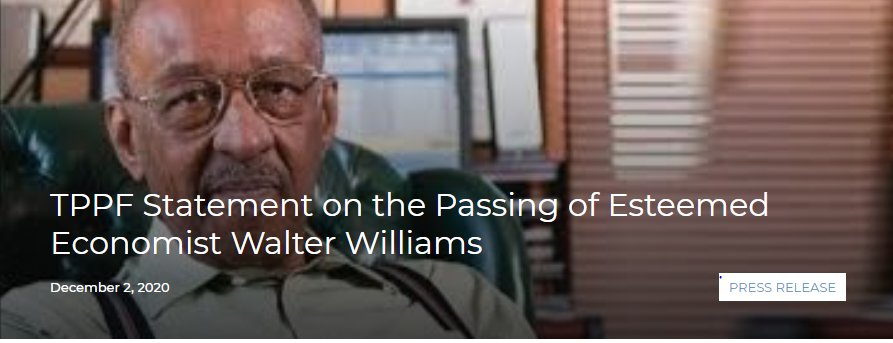 We at the Texas Public Policy Foundation are saddened to learn of the passing of economist Walter E. Williams.
“Walter Williams’s journey from the projects of Philadelphia to a professorship in economics at George Mason University—and becoming one of the most recognized and respected conservative voices of our time—was remarkable,” said TPPF Executive Director Kevin Roberts. “His great gift was communicating complex economic principles in everyday language. Always a cheerful combatant—yet one who would ‘Suffer No Fools,’ as the title of a documentary about him pointed out—Walter was an effective advocate for freedom.” “There are few people who so eloquently explained how people can prosper—given scarce resources and limited government involvement—than the free market economist Walter Williams,” said TPPF Chief Economist Vance Ginn. “It was a pleasure to read and learn from his many academic publications, commentaries, and books over the years. While it’s a day to mourn his loss, let’s also celebrate his many gifts to us and continue to build on them, so that every person has the best chance to thrive in life—like he did.” https://www.texaspolicy.com/press/tppf-statement-on-the-passing-of-esteemed-economist-walter-williams Could you have imagined, just a few short months ago when we had one of the best U.S. economies on record, that we would be facing one of the worst today?
It’s difficult to do. But the disruptions caused by fear of COVID-19 and the shutdowns ordered by state and local governments have dramatically changed our lives — so much so that it’s difficult for many to have hope in a prosperous future. This recession should be called the Great Disruption. But we can look to that roaring economic situation in February for guidance in finding the path to increasing our freedoms and flourishing now, no matter the circumstance. This begins with responsibly ending the shutdowns ASAP. We should look at the data and understand there is still a need to protect our vulnerable populations — but our kids should get back to school and us healthy adults should get back to work. We take on risk every day, and even the shutdowns aren’t without risk. The data keep pouring in, demonstrating that in this case, the cure has been worse than the disease. Researchers from top institutions looked at the data on fatalities related to COVID-19 and those losses of life from unemployment and missed health care due to the shutdowns. What they find is startling: “the disease has been responsible for 800,000 lost years of life so far” while the lockdowns are responsible for a conservative estimate of “at least 700,000 lost years of life every month, or about 1.5 million so far.” In other words, the costs of the shutdowns on lost life-years is almost double that from COVID-19. The value of life is hard to measure because each one is beautiful. That’s why it’s disturbing that the deaths from issues related to the shutdowns seem to be far exceeding those directly related to the disease. Economist Casey Mulligan, who is a Professor at the University of Chicago and was recently the Chief Economist at the White House’s Council of Economic Advisers, has been tracking the daily cumulative costs of the COVID-19 pandemic at pandemiccosts.com. Mulligan notes that these costs were at least $1.3 trillion in total, or $10,954 per household through May 22. This includes mortality costs and market and nonmarket costs of shutting down the economy. And this is just through May 22. Consider the lost economic output on an annualized basis of -5 percent in the first quarter of 2020 and of a projected record -40 percent in the second. Compare this with the growth we could have had if pro-growth policies in President Trump’s budget that I helped craft had been implemented, and that’s roughly $2 trillion in lost prosperity. If you add the more than $9 trillion Congress has approved in financial assistance packages, then you’re talking about nearly half of the economy being redistributed in some capacity — in a very short period. This is certainly the greatest disruption ever and the swiftest redistribution ever — both of which will cause massive distortions throughout our livelihoods, including for future generations, and will need to be corrected soon. And now, states are asking for more federal bailouts (when they’ve already been authorized to get about $1 trillion). Bailouts will only enable blue states to extend their costly shutdowns and continue their poor fiscal policies, which long predate the pandemic. Yet House Democrats are prepared to grant the states’ requests, as they have passed another $1 trillion in state bailouts in the HEROES Act. We must not let this happen. Let’s not let this COVID-19 crisis go to waste, though. Let’s learn from our mistake — shutting down the economy is a cure clearly worse than the disease. What should the path forward look like? Responsibility, not restrictions. Social distancing, not shutdowns. And governments and civil society must be better prepared for major costly events. After ending the shutdowns, a way to ensure this is by passing the Workplace Recovery Act. This Act would direct federal funds to assist any business that experienced losses due to the shutdowns out of their control. It would provide the operating cash businesses need to survive and employ workers. And while I’d prefer not one more dime be authorized, this proposal would work as a targeted automatic stabilizer until normality returns where businesses hire workers to not waste taxpayer money. And if there’s a double-dip recession caused by shutdowns due to another wave of COVID-19, then Congress doesn’t need to pass more massive spending bills that bankrupt future generations. The WRA isn’t a silver bullet, but it will help give Americans confidence that no other legislation yet has. We’ve had a natural experiment on how to deal with a pandemic. There were the best of intentions. But as Milton Friedman said, “One of the great mistakes is to judge policies and programs by their intentions rather than their results.” The results show we have much to learn, but an important one is governments should never shutdown our freedoms again. Vance Ginn, Ph.D., is Chief Economist at the Texas Public Policy Foundation in Austin, Texas. He is the former Associate Director for Economic Policy of the Office of Management and Budget at the Executive Office of the President. https://thehill.com/opinion/finance/502518-we-must-learn-from-the-shutdown-mistake In this Let People Prosper episode, we discuss the key elements of real property tax cuts (slower growth rates and lasting tax reductions), movement afoot to eliminate civil asset forfeiture, and potential expansions in local liberty that are being discussed at the Texas Legislature. As we get closer to the end of session, these are critical aspects that you don't want to miss.
#letpeopleprosper Texas Model Helps to Let People Prosper - Presentation on Texas' Economic & Fiscal Situation4/1/2019 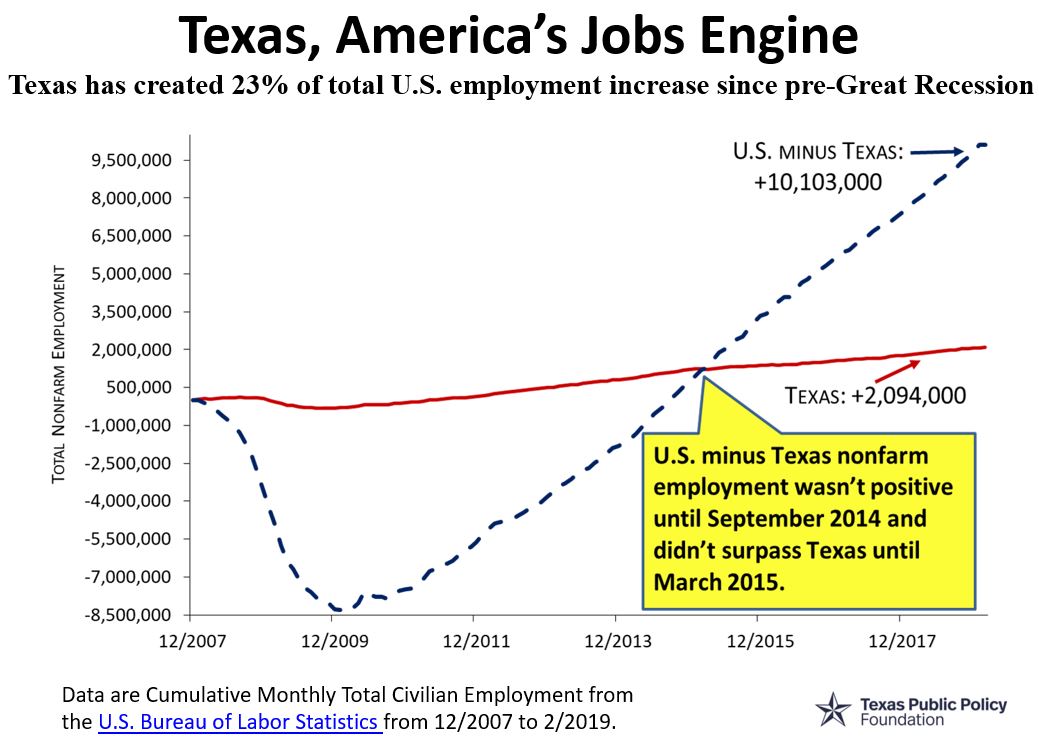 The latest BLS state-level jobs report for February shows that Texas continues to lead the way in job creation for the last 12 months and keeps the state's near record low unemployment rate of 3.8%. Here's the statement by the Texas Workforce Commission. The presentation below provides an overview of Texas’ economic, labor market, and fiscal situation while also comparing Texas with other large states. There are also policy recommendations to strengthen the Texas Model of limited government so that it can foster more individual liberty and economic prosperity. My prior research on how institutions matter takes a deeper dive into these figures. I recommend reading it along with watching my vlog on the subject. To summarize, Texas should increase economic freedom by eliminating unnecessary government barriers to competition to let people prosper. Watch my explanation of previous state-level labor reports and other videos at my YouTube channel: Vance Ginn Economics. https://www.texaspolicy.com/blog/detail/texas-economic-labor-market-and-fiscal-situation 
 Current Events Friday includes Jobs Report, Annexation, & Criminal Justice Reforms: LPP Ep 793/8/2019 In this Let People Prosper episode, James Quintero, Dr. Derek Cohen, and I discuss today's release of reports on the U.S. and Texas jobs picture, movement on annexation reform (HB 347), and various issues related to criminal justice reforms (HB 63). Find more of TPPF's work at www.txlegehub.com.
#LetPeopleProsper In this Let People Prosper episode 75, Chance Weldon of TPPF's Center for the American Future joins James Quintero and me to discuss today's Supreme Court ruling that's a win for people and for TPPF. James discusses his recent testimony before the Texas House Public Education Committee in support of House Bill 134 that increases bond transparency. I discuss my recent testimony before the Texas House Ways & Means Committee at the 45-minute mark here (written testimony) on ways to strengthen the Texas Model.
#LetPeopleProsper In this Let People Prosper episode, James Quintero, Derek Cohen, and I discuss key topics this week for Current Events Friday.
More to come on Monday. #LetPeopleProsper It's Current Events Friday!
In this Let People Prosper episode 72, James Quintero, Dr. Derek Cohen, and I discuss this week's current events. The big stories this week are Governor Abbott's State of the State, President Trump's State of the Union, and property tax hearing held by the Texas Senate Committee on Property Taxes. We dive into each of these issues to consider which government actions preserve liberty and which ones don't. Regarding property taxes, there's some hope in sight! Senate Bill 2 could provide historic property tax reform (read my written testimony and watch testimony at time 1:13:10) that would put in place a 2.5% property tax revenue rate that would trigger an automatic election in November for a local government that wanted to increase their revenue above that point. This reform is an essential element for any property tax relief of lowering property tax bills like TPPF’s plan to eliminate the school M&O property tax over time by slowing spending growth. #letpeopleprosper In this Let People Prosper episode 69, I sit down with James Quintero, director of the Think Local Liberty project, and Dr. Derek Cohen, director of the Right On Crime project, to discuss the Texas budget, ban-the-box, and annexation.
You don't want to miss this first episode of many where we'll address a number of good, bad, and pretty good bills that influence our prosperity throughout session while giving you a heads up on which bills will be heard in committee so you can make your voice heard. In this episode we discuss the state's recommended budgets by the House and Senate and how they compare with the Conservative Texas Budget, bad bill of HB 495 related to criminal history, and a prosperity-enhancing bill of HB 347 related to annexation that builds on passage of SB 6 during the 2017 special session. #LetPeopleProsper |
Vance Ginn, Ph.D.
|
||

 RSS Feed
Proudly powered by Weebly